How to Make Decisions When You Feel Lost: A Framework That Actually Works

You're not confused because you're weak. You're confused because you're standing at a crossroads nobody gave you a map for—and most decision-making advice was written for people who already know what they want.There’s a particular kind of paralysis that hits when life has lost its texture. Not just “I can’t choose between two jobs”—but the deeper, murkier version: I don’t even know what I value anymore. I don’t know who I’m making this decision for.
That’s what “feeling lost” actually means. And it requires a different approach than a pros-and-cons list.
This article won’t give you ten cheerful steps. It’ll give you an honest look at why decisions feel impossible when you’re disoriented—and a real framework for moving through it.
Why Decision-Making Breaks Down When You Feel Lost
Most decision-making models assume one thing: that you have a stable self to make decisions from. A clear set of preferences. A sense of what you’re moving toward. When that foundation erodes—after a breakup, a career failure, burnout, grief, or simply years of drifting—those models stop working.
Take stock of your motivation architecture. For each major commitment in your life—career, creative work, relationships, and public identity—ask, “Am I doing this because it’s important to me, or because it will generate approval?” Be honest. Don’t be defensive.
Create feedback-free zones. Spend intentional time working without an audience and with no metrics. Journal without publishing. Make something without sharing it. Develop skills privately. This rebuilds the neural pathway between action and intrinsic satisfaction.
Practice sitting with the discomfort of invisibility. When you do something and get no response, resist the urge to seek feedback. Let the discomfort be information. What does that reveal about where your sense of worth resides?
Ask yourself the “empty room” question regularly. If no one ever knew you did it, would you still do it? The answer reveals your true values with a precision that no personality test can match.
Distinguish between “I need approval” and “I need connection.” These are often conflated but are distinct. Wanting to be understood, to be valued, to contribute—these are relational needs and healthy. Wanting to move up the metrics—that’s the loop. You don’t have to feed one to feed the other.
Create a private record of your decisions. Start predicting and evaluating your work before you show it to anyone. Note your evaluation. Then compare it to the feedback of others. Over time, you calibrate your internal compass by practicing it.
This isn’t a motivation problem. It’s a disorientation problem. And the solution isn’t to push harder. It’s to reorient first.
The Hidden Reason You Keep Avoiding the Decision
Here’s something most articles won’t say: avoidance is often intelligent.
When you repeatedly delay a decision, it’s rarely pure laziness. More often, one of three things is happening:
- The real question is buried. You’re trying to decide whether to move cities, but the actual question is whether you want the life you’ve been building at all.
- You’re afraid of foreclosing identity options. Choosing one path feels like saying “no” to a version of yourself you’re not ready to let go of.
- You’ve been using external validation as a compass. Without approval from certain people, you’ve lost your north star—and didn’t notice until now.
Viktor Frankl wrote in Man’s Search for Meaning that suffering without meaning becomes unbearable. The same applies to uncertainty: being lost without a framework for thinking about it becomes mentally destabilizing. The goal isn’t to eliminate uncertainty—it’s to make it navigable.
A Framework for Making Decisions When You’re Disoriented
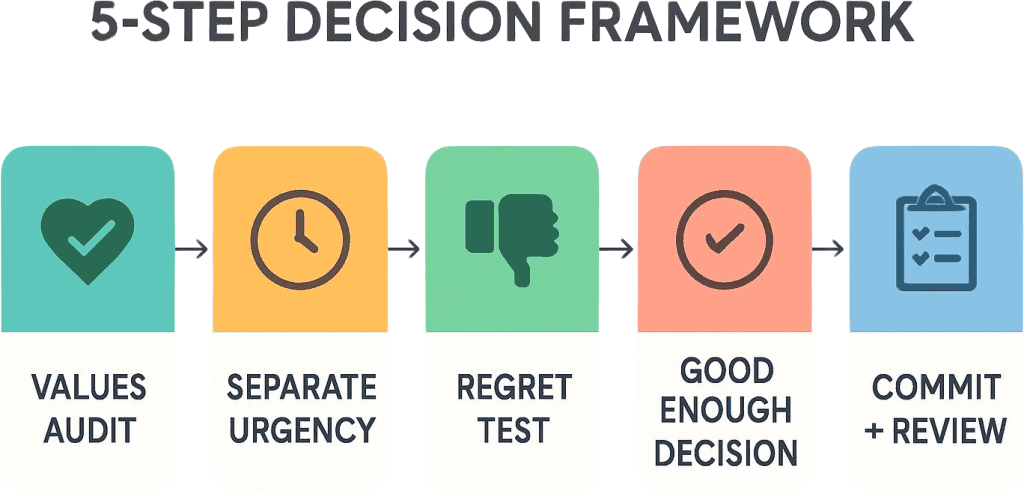
Step 1: Stop trying to make the “right” decision.
The biggest cognitive trap when you feel lost is optimizing for correctness. You keep analyzing because you believe there’s a right answer you haven’t found yet. But in most major life decisions—especially during disoriented periods—there is no objectively right answer. There are only decisions that are more or less aligned with who you’re becoming.
Shift the question from “What’s the right choice?” to “What kind of person does this decision move me toward being?”
That reframe matters. The first question has a hidden assumption: that you can predict outcomes well enough to identify the correct path. You can’t. The second question focuses on values and direction—things you can actually access right now.
Step 2: Run a values audit, not a pros-and-cons list
Pros-and-cons lists are useful for decisions where your values are already clear. When you’re lost, you first need to excavate what you actually value—not what you think you should value and not what you valued five years ago.
Try this instead: write down the last five moments in the past year when you felt genuinely alive. Not happy necessarily—alive. Engaged. Like yourself. What were you doing? Who were you with? What was the stakes level?
Now look at your decision through that lens. Which option gives you more of those conditions? That’s not a guarantee — but it’s a real signal.
Martin Seligman’s PERMA model (Positive Emotion, Engagement, Relationships, Meaning, Accomplishment) offers a more granular lens. If you’re choosing between two life paths, ask honestly: which one is more likely to give you genuine engagement, not just achievement?
Step 3: Separate urgency from importance.
One of the cruelest tricks anxiety plays is making everything feel equally urgent. When you’re lost, the decision about what to eat for dinner carries the same emotional weight as whether to quit your career. This is a symptom, not reality.
Ask yourself: If I don’t make this decision in the next 30 days, what actually happens? For many “urgent” decisions, the answer is “not much.” This isn’t permission to avoid indefinitely—it’s permission to stop treating every choice as a crisis.
The decisions that genuinely require speed are actually rare. Most allow for a period of deliberate slowness—gathering information, sitting with discomfort, waiting for clarity that comes through action rather than analysis.
Step 4: Use the “regret minimization” test—carefully.
Jeff Bezos famously described projecting himself to age 80 and asking which choice he’d regret more. It’s a useful heuristic, but with one major caveat: when you’re lost, your imagination of your “future self” is compromised. You’re projecting from a disoriented present.
A more honest version: Ask which decision you’d regret more if the person you’re becoming turns out to be more courageous than you currently feel. Not who you are now—who you sense you’re capable of being.
That’s a subtle but critical difference. It prevents you from making decisions based on a diminished self-image.
Step 5: Make a “good enough for now” decision.
Harvard’s Grant Study—the longest longitudinal study on adult development—found that the single strongest predictor of life satisfaction wasn’t the quality of decisions made but the capacity to adapt after decisions. People who thrived weren’t better at choosing. They were better at making meaning from whatever they chose.
This doesn’t mean decisions don’t matter. It means that waiting for perfect clarity before acting is itself a kind of decision—and often the most costly one.
Give yourself a timeframe. Tell yourself: I will make a good enough decision by [specific date], and I will commit to it for [specific period] before reassessing. This removes the illusion that more time will bring certainty. It rarely does. What brings clarity is usually action.
What to Do When You Still Can’t Decide
Sometimes you’ve done everything above and you’re still stuck. That’s real, and it deserves honesty.
A few possibilities worth considering:
- The decision isn’t yours to make yet. You might be waiting on external information, a conversation, or an event that hasn’t happened. That’s not paralysis—that’s appropriate timing.
- You’re choosing between two losses, not two gains. Sometimes being “lost” means you’re grieving something regardless of what you choose. No decision will prevent the loss—and accepting that can itself be freeing.
- You need an outside voice. Not for validation, but for reality testing. Talking to a therapist, mentor, or trusted person who won’t simply agree with you can surface the blind spots that solo analysis never reaches.
The Mistake Almost Everyone Makes
The most common error people make when feeling lost isn’t making the wrong decision. It’s treating the feeling of lostness as evidence that they’re broken.
They’re not. Feeling lost is almost always a sign that you’ve outgrown a previous version of yourself and haven’t yet consolidated the next one. It’s a developmental passage, not a personal failure.
The psychologist James Marcia described “identity moratorium”—a stage where the self is actively in flux, commitments are suspended, and exploration is happening. Most people experience multiple moratoriums across a lifetime, not just in adolescence. If you’re in one now, trying to force a permanent decision may be working against your own growth process.
That doesn’t mean do nothing. It means choose actions that keep options open while moving you forward—rather than paralysis disguised as deliberation.
A Final Reframe Worth Sitting With
The question isn’t “How do I make the right decision when I feel lost?” The better question is, “What kind of decision-maker do I want to become?”
Because the goal isn’t to solve this one crossroads. It’s to develop the capacity to navigate crossroads—which means building a stronger relationship with your own values, tolerating uncertainty without fleeing into false certainty, and learning to act before you feel ready.
That’s a lifelong skill. And every lost moment, handled with even minimal intentionality, sharpens it.
You don’t need to know where you’re going. You need to take a step that’s honest. The direction usually reveals itself in the movement.
FAQs/PPA
How do you make a decision when you don’t know what you want?
Start by identifying what you don’t want—this is often clearer. Then look at moments in recent memory when you felt most engaged or alive, and use those as a values signal. You don’t need to know your destination; you need a direction. Small actions in any direction tend to generate more clarity than extended analysis.
What causes decision paralysis when feeling lost?
Decision paralysis when lost is usually caused by identity disruption—when your sense of self is unclear, every choice feels like a statement about who you are. This is compounded by anxiety, which inflates the stakes of every decision equally. The paralysis isn’t about the decision itself; it’s about the underlying disorientation.
Is it normal to feel lost and unable to make decisions?
Yes, and it’s more common than people admit. Psychologists identify “identity moratorium”—a period of suspended commitment and active questioning—as a normal developmental process that happens multiple times across a lifetime, not just in adolescence. Feeling lost is often a sign of growth, not failure.
How do you trust yourself to make the right decision?
Trust isn’t a precondition for deciding—it’s built by deciding. Start with lower-stakes choices and follow through. Notice what happens. Trust in your own judgment comes from evidence accumulated over time, not from feeling confident before acting. Waiting until you “trust yourself” is often a form of avoidance.
What is the best strategy for making life decisions when confused?
A values-first approach works better than a pros-and-cons list when you’re confused. Identify what conditions make you feel most like yourself, then assess your options through that lens. Additionally, set a decision deadline—clarity rarely arrives through more analysis; it usually comes through committed action.
How long should you wait before making a big decision?
Long enough to reality-test your options, talk to the right people, and sit with the discomfort—but not so long that waiting becomes avoidance. For most major life decisions, two to four weeks of deliberate reflection is sufficient. Beyond that, more time typically adds anxiety, not clarity.
Can therapy help with feeling lost and indecisive?
Yes, significantly. Therapy—particularly acceptance and commitment therapy (ACT) and person-centered approaches—helps people clarify values, identify avoidance patterns, and develop tolerance for uncertainty. It’s especially useful when lostness stems from grief, burnout, or major life transitions, where solo reflection hits its limits.
What does it mean when you can’t make decisions anymore?
Persistent inability to make even small decisions can be a symptom of depression, burnout, or anxiety disorder—not just situational confusion. If decision paralysis is pervasive, long-lasting, and accompanied by low energy or loss of interest, it’s worth speaking with a mental health professional rather than treating it as a strategy problem.