How External Validation Destroys Personal Purpose

In today’s hyper-connected world, the pursuit of external approval has become an invisible force that silently drives our choices, goals, and sense of identity. From social media metrics to workplace recognition, we’re forced to measure our worth by the eyes of others. But beneath the surface of this approval-seeking behavior lies a dangerous truth: How External Validation Destroys Personal Purpose, slowly replacing authentic self-discovery with a performance-driven existence. When your life becomes a platform for the opinions of others, you lose touch with the inner compass that once guided your deepest ambitions and values.
The impact of relying on external validation extends far beyond temporary dissatisfaction—it fundamentally undermines your ability to define and pursue meaningful goals. Understanding How External Validation Destroys Personal Purpose reveals a pattern where your decisions are no longer rooted in what will fulfill you but in what will impress others. This shift creates a hollow version of success: one that may look impressive on the outside but feels increasingly empty on the inside. Reclaiming your personal purpose requires recognizing this destructive pattern and intentionally rebuilding your life around intrinsic values rather than external praise.
You did the work. Got the grades, the job, the likes, the nods of approval. And somewhere along the way, without really deciding to, you built your entire sense of purpose around whether other people affirmed it. Now you can't tell what you actually want—because you've been answering that question with someone else's applause for so long, your own voice has gone quiet.
This is not a character flaw. It is a psychological mechanism—and one of the most effective, invisible ways in which a person loses touch with their purpose.
This article is about how this happens, why it is so hard to remember, and what it really takes to rebuild a sense of purpose that comes from within, not from without.
The Neuroscience of Approval: Why Validation Is Addictive
When someone compliments you, your brain releases dopamine—the same neurotransmitter involved in eating, sex, and substance use. This is not a metaphor. Neuroimaging research shows that social recognition activates the brain’s reward circuitry in much the same way that other primary rewards do.
The problem isn’t that being recognized makes you feel good. That’s normal, human, and healthy in moderation. The problem is what happens over time: The brain starts to expect validation, calibrates effort toward it, and eventually needs it to feel motivated. Recognition stops being a bonus and becomes an engine.
Once that changes, you’re no longer pursuing goals because they mean something to you. You’re pursuing them because the cycle of external feedback—praise, approval, recognition—your nervous system has learned to treat as a goal. And like any addictive loop, tolerance builds. You need more validation to feel the same sense of meaning. The praise that once felt important starts to feel thin. You post, you publish, you showcase—and you scan obsessively for feedback.
Researcher Brené Brown has written extensively on the shame-vulnerability cycle that underpins approval-seeking behavior: when our sense of worthiness is conditional on others' perceptions of us, we become experts at managing their impression rather than living our actual lives.
The Borrowed Identity: What Happens When Approval Becomes Who You Are
There’s a concept worth naming explicitly: borrowed identity. It’s what you build when, over time, your self-concept is gathered primarily from other people’s reflections of you rather than your own life experiences.
It works like this: You seek approval for being smart, motivated, helpful, and successful. You start to display those qualities more consciously—not because you’re fake, but because the approval feels good and you want it more. Over the years, those externally reinforced traits become your identity. The performance becomes the persona.
The cost? You lose access to parts of yourself that were never displayed for anyone. Your quiet interests, your undiscovered passions, who you are at 2 a.m. when no one is looking—these are crowded out by the curated version. And when validation finally slows down, or when the audience changes, or when you achieve a goal and find it hollow—there’s nothing beneath the borrowed identity. Without the mirror, you don’t know who you are.
Psychologists call this "contingent self-esteem"—a self-worth that is experienced as dependent on external events and others' evaluations. Research by Jennifer Crocker at the University of Michigan found that people with high contingent self-esteem experience greater fluctuations in well-being, more anxiety, and ultimately lower life satisfaction than those whose self-worth is stable and internally grounded.
How Social Media Industrialized the Validation Economy
Before social media, external validation required physical presence and real-time interaction. Your social feedback loop was limited in scope—a few dozen people at most. Today, that loop operates on an industrial scale, 24 hours a day, and is designed by engineers whose job it is to maximize the number of times you check it.
Likes, follower counts, comments, shares—these are quantifiable acceptance metrics. And the platforms that host them are built on the same basic insight: the anticipation of a variable reward keeps people engaged for much longer than a guaranteed reward. Casinos work the same way. You never know when a slot machine will pay out—and that uncertainty keeps you pulling the lever.
When you post something and wait to see how it performs, your brain is in that window of uncertainty. Dopaminergic. Attentive. Hooked. The platform benefits from your validation loop regardless of whether or not it serves your purpose.
None of this is new information. The second-order effect is what’s missing: The longer you work within this system, the more your sense of what’s important becomes calibrated by performance. Not consciously, but your sense of intrinsic worth quietly shifts toward what’s gaining traction. Ideas that don’t get engagement start to feel less important. The parts of your life and work that are truly meaningful but unglamorous fade from your attention.
This is how external validation doesn't just distract from personal purpose—it rewires the very instrument you'd use to find it.
8 Ways External Validation Quietly Erodes Personal Purpose
1. You pursue goals you can announce, not goals that mean something
Validation requires an audience. Over time, people begin gravitating toward goals that are legible and impressive to others—and away from goals that are private, strange, or hard to explain. The work you’d do if no one were watching loses priority. The work that looks good in a LinkedIn post gains it.
2. You mistake applause for alignment
When something you do generates strong approval, it creates a false sense of rightness. “People like it, so this must be my purpose.” But external resonance and internal resonance are not the same thing. Many people do things that the audience likes and privately feel hollow. Approval is real. The purpose is not there.
3. You lose tolerance for invisibility
Work that matters often requires long stretches of no feedback—building something in private, thinking without publishing, developing a skill without an audience. When your sense of progress is calibrated by external response, invisibility feels like failure. You start abandoning things that haven’t gotten traction yet. You stop before purpose has time to develop.
4. Your opinions become positions
Genuine purpose requires genuine thought—the kind that involves uncertainty, contradiction, and revision. Validation-seeking turns thought into performance. You begin staking out positions that play well rather than thinking things through honestly. Over time, you lose the capacity for intellectual honesty with yourself because you’ve been performing certainty for so long.
5. You compare your internal experience to others’ external presentation
You see someone else’s highlights—their praise, their accolades, their visible momentum—and measure your private doubts against it. This comparison is structurally unfair and psychologically corrosive. It makes your internal world feel inadequate against a fiction.
6. You outsource your self-trust
When approval is your primary feedback mechanism, you stop developing your own judgment. You don’t know if something is good until others confirm it. You don’t know if a decision is right until it’s validated. This isn’t low self-esteem in the conventional sense—it’s an atrophied internal compass. You’re not incapable of judgment; you’ve just stopped practicing it.
7. You become risk-averse in the wrong ways
The fear isn’t failure—it’s disapproval. And those are different risk calculations. A person afraid of failure might still take bold, unconventional steps. A person afraid of disapproval avoids anything that might attract judgment, confusion, or rejection—even when those things would move them closer to something real.
8. You feel purposeless even when “doing well.”
This is the final and most confusing symptom: life looks fine from the outside, metrics are up, people are impressed—and you feel nothing. Not depression, exactly. Just an absence of meaning. Because purpose was never actually there. You built the house on someone else’s land.
The Paradox of High Achievers: The More Validated, the More Lost
Here’s the opposite: The people most damaged by external validation dependency are often high achievers. Not because they’re weak, but because their validation loop worked. They got the grades, the promotions, the recognition—and so they never had a reason to question the system. The rewards kept coming.
The problem lies in the silence after achievement. When a goal is reached, the validation peaks—and then fades. What’s left? If you’ve never developed a sense of purpose independent of that external validation, the silence after achievement is bewildering. You’ve succeeded on every level and still feel empty.
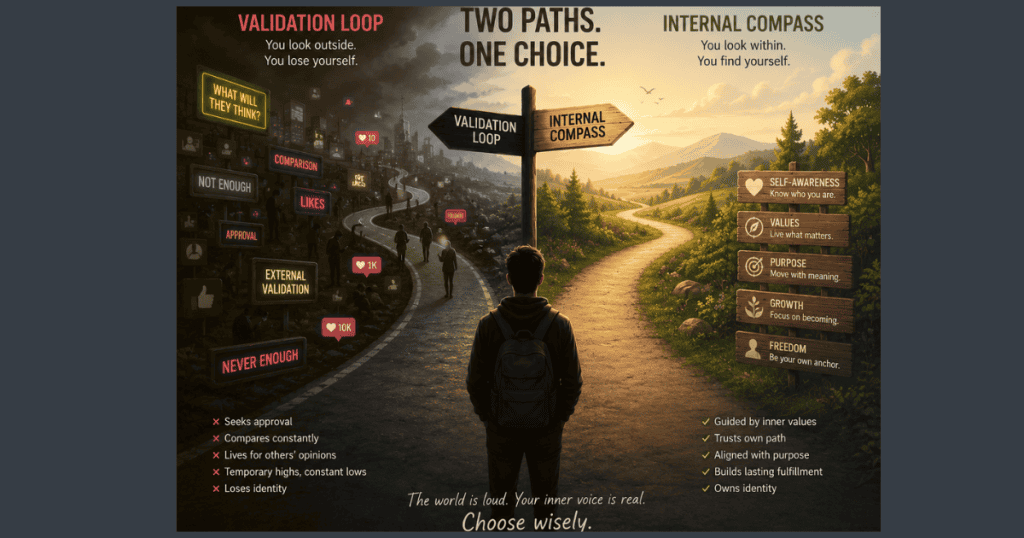
Viktor Frankl called it “existential emptiness”—the experience of meaninglessness when a person discovers that their goals, even if achieved, don’t fulfill a deep need for meaning. In his observation, this emptiness often precedes lives lived in conformity to what others expect rather than authentic inner direction.
Healthy Recognition vs. Validation Dependency: An Important Distinction
Wanting recognition is not pathological. Humans are social animals. Caring about how others perceive you is adaptive, not a flaw. The line worth drawing is between two different relationships to approval:
- Healthy recognition-seeking: You do work that matters to you. You’re pleased when others respond well to it. Their approval adds to your satisfaction but doesn’t create it. If the approval doesn’t come, the work still felt worth doing.
- Validation dependency: The approval doesn’t add to your satisfaction—it produces it. Without the external response, the work feels meaningless. You can’t assess whether something was good, worth doing, or valuable without the audience’s verdict.
The test is simple and uncomfortable: if all external feedback disappeared—no comments, no metrics, no compliments—would the work still feel worth doing? Would you know what to pursue? If the honest answer is no, the dependency is real.
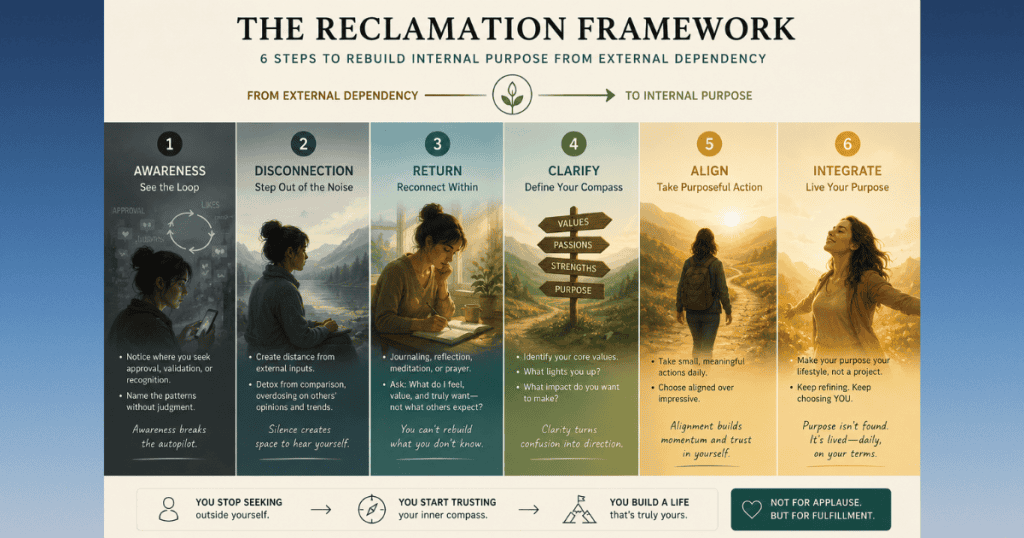
The Reclamation Framework: Building an Internal Compass
Rebuilding a sense of purpose that doesn’t require external confirmation isn’t a weekend project. It’s a reorientation—slow, often awkward, and worth every difficult moment of it. Here’s a practical framework:
- Audit your motivation architecture. For each major commitment in your life—career, creative work, relationships, public identity—ask: am I doing this because it matters to me, or because it produces approval? Be honest. Not defensive.
- Create feedback-free zones. Spend deliberate time doing things with no audience and no metrics. Journal without publishing. Make something without sharing it. Develop a skill privately. This rebuilds the neural pathway between action and internal satisfaction.
- Practice sitting with discomfort of invisibility. When you do something and get no response, resist the urge to seek response. Let the discomfort be information. What does it reveal about where your sense of worth lives?
- Ask yourself the “empty room” question regularly. If no one would ever know you did this—would you still do it? The answer reveals your actual values with precision that no personality test can match.
- Distinguish between “I want approval” and “I want connection.” These are often conflated but different. Wanting to be understood, to matter to others, to contribute—these are relational needs and healthy. Wanting the metrics to go up—that’s the loop. Feeding one doesn’t require feeding the other.
- Build a private record of your own judgment. Start making predictions and assessments about your own work before showing it to anyone. Note your evaluation. Then compare it to others’ responses. Over time, you calibrate your internal compass by practicing it.
The goal is not to stop caring what people think. It's to stop requiring what they think in order to know what you think.
Common Mistakes People Make When Trying to Stop Seeking Validation
- Performing not-caring: Publicly declaring that you don’t care about likes and views—for the engagement. This is the validation loop disguised as its own solution.
- Cold turkey withdrawal: Abruptly leaving all platforms, burning your professional network, withdrawing from public life entirely. Overcorrection rarely produces clarity—it produces isolation.
- Replacing one audience with another: Moving from mainstream approval to counter-culture approval is still approval-seeking. The audience changed; the dependency didn’t.
- Confusing purpose with productivity: Filling the approval-vacuum with relentless busyness. Staying so active you never have to sit with the discomfort of not knowing what you actually want.
- Expecting the internal compass to appear immediately: After years of outsourcing your direction to others, your own judgment will feel unreliable at first. That’s not a sign it’s broken—it’s a sign it’s rebuilding. The discomfort of uncertainty is not a problem to solve. It’s the sensation of regaining something real.
Key Takeaways
- External validation is neurologically rewarding—which is precisely what makes it dangerous when it becomes your primary source of purpose.
- The borrowed identity—built from others’ reflections rather than your own experience—is structurally hollow and will fail you when the audience changes or disappears.
- Social media has made the validation economy nearly invisible and structurally addictive. The longer you operate inside it unreflectively, the more your sense of what matters gets shaped by what performs.
- High achievers are often more vulnerable to validation dependency, not less—because the loop worked for them and they never had to question it.
- The distinction between healthy recognition-seeking and validation dependency comes down to one question: can you assess the value of your work without external input?
- Rebuilding an internal compass is gradual, uncomfortable, and necessary. The sensation of uncertainty when external feedback disappears is not a problem—it’s a starting point.
FAQs/PPA
How does seecking external validation affect your sense of purpose ?
Seeking external validation gradually shifts your motivation from intrinsic (doing things because they matter to you) to extrinsic (doing things to receive approval). Over time, your goals become shaped by what is legible and impressive to others rather than what is genuinely meaningful. You lose the habit of trusting your own assessment, and purpose—which requires internal direction—erodes as a result. You may still be productive and recognized, but the sense of meaning behind the action quietly disappears.
How do I feel empty wven when people approve of me ?
Because approval and meaning are not the same thing, and your brain knows the difference even when your conscious mind has conflated them. Dopamine from social approval is real but short-lived—it spikes and fades. Meaning, by contrast, is a sustained experience that comes from acting in alignment with your own values and direction. When you’ve built your life primarily around the approval loop, the moments after the approval fades reveal what was never there: a deeper sense of why you’re doing any of this for yourself.
What is the difference between external validation and healthy recognition ?
With healthy recognition, the work matters to you regardless of whether it’s acknowledged—approval adds to your satisfaction but doesn’t create it. With validation dependency, the approval is what produces the sense of value. Without it, the work feels purposeless. The practical test: if all feedback disappeared permanently, would you still know what to pursue and why? If yes, your recognition-seeking is healthy. If the honest answer is no—that’s dependency.
How do I stop needing external validation to feel fulfilled ?
Rebuild your internal compass gradually rather than trying to detach cold turkey. Create feedback-free zones—do work privately without sharing, make things without posting, develop skills without an audience. Regularly ask yourself the “empty room” question: if no one would ever know you did this, would you still do it? Over time, this practice rebuilds the neural connection between action and internal satisfaction that validation dependency has weakened. Expect discomfort—it’s part of the process, not a sign something is wrong.
Does socila media cause validation dependency ?
Social media doesn’t create the underlying tendency toward approval-seeking—that’s deeply human. What it does is industrialize and quantify it, making the validation loop faster, more measurable, and structurally designed to keep you engaged. The variable reward mechanism (not knowing when a post will perform well) is neurologically identical to gambling. Over time, operating inside this system without awareness calibrates your sense of what matters toward what gets engagement—gradually shifting your purpose toward performance rather than genuine direction.
Can you lose your sense of self from seeking too much approval ?
Yes—this is what psychologists call the “borrowed identity.” When your self-concept is assembled primarily from others’ reflections of you rather than your own lived experience, you lose access to the parts of yourself that were never performed for an audience. You become the curated version. When the audience changes or the approval fades, there’s often a profound disorientation—not because you’ve failed, but because the identity you’d built was never quite yours to begin with. Rebuilding it requires turning back toward your own unwitnessed experience.