What Is Your Soul Urge Number in Numerology—and What Does It Actually Reveal About You?
There’s a difference between what you want and what you need at the level of the soul. Numerology’s soul urge number, also called the heart’s desire number, attempts to map that deeper layer—the motivational architecture underneath the choices you make and the patterns you can’t seem to escape.
Whether you approach numerology as a spiritual system or simply as a structured framework for self-reflection, the soul urge number offers something genuinely useful: a mirror held up to your inner life that most personality systems don’t reach.
Most numerology content tells you your soul urge number and then gives you a flattering personality description. That's not what this is. This is about understanding why you keep being pulled toward certain things—even when they conflict with your goals, your relationships, or your own logic.
This article explains exactly what the soul urge number is, how to calculate it precisely, and what each number reveals—and perhaps more importantly, what it means when your soul urge conflicts with the life you’ve been building.
What Is the Soul Urge Number in Numerology?
The soul urge number is one of the five core numbers in numerology—alongside the life path number, expression number, personality number, and birthday number. Each is derived from your birth name or birth date, and each maps a different dimension of your experience.
The soul urge number is derived exclusively from the vowels in your full birth name—the name exactly as it appears on your birth certificate. This is not arbitrary. In many ancient traditions, vowels were considered the “breath” of a word, its animating force. In Pythagorean numerology—the system most Western numerologists work within—consonants are associated with the outer personality, while vowels are associated with the inner, often hidden, motivational drive.
The core idea: your soul urge number reveals what you are driven by at the level beneath conscious choice. It describes the emotional and psychological needs that, when met, create a sense of deep fulfillment—and when chronically unmet, create a persistent sense of something being wrong even when nothing on the surface is.
This is a critical distinction. The soul urge number isn’t about what you’re good at. It isn’t about your public personality or your destiny. It’s about what your inner self is fundamentally oriented toward—the engine beneath the surface.
Quick reference for all soul urge numbers—core drive, deepest need, and primary shadow for each. Click any card for a deeper reading in the Article tab.
1-Sovereignty
Core drive: autonomy and self-direction. Deepest need: to know choices are genuinely your own. Shadow: confusing independence with isolation.
2-Union
Core drive: deep connection and partnership. Deepest need: to be truly seen in a relationship. Shadow: harmony through self-suppression.
3-Expression
Core drive: to create and communicate. Deepest need: to be genuinely heard. Shadow: scattering gifts across too many outlets without depth.
4-Foundation
Core drive: stability and tangible building. Deepest need: solid, lasting ground. Shadow: choosing security over necessary growth.
5-Freedom
Core drive: variety and full experience. Deepest need: to feel life is open, not a corridor. Shadow: treating depth as a constraint.
6-Love
Core drive: nurturing and responsibility. Deepest need: to feel genuinely needed and contributing. Shadow: Care is sliding into control.
7-Truth
Core drive: depth of understanding. Deepest need: inner knowledge and real reflection. Shadow: analysis replacing lived experience.
8-Mastery
Core drive: scale, impact, tangible results. Deepest need: to feel effort matters measurably. Shadow: impact as the only measure of worth.
9-Service
Core drive: humanitarian contribution. Deepest need: to leave something better than found. Shadow: idealism producing constant disappointment.
11-Illumination
Master number. Core drive: spiritual insight and inspiration. Deepest need: elevated understanding brought into real life. Shadow: sensitivity without grounding.
22-Legacy
Master number. Core drive: large-scale, lasting contribution. Deepest need: to build something that outlasts a personal lifetime. Shadow: vision so large it produces paralysis.
Soul Urge vs. Life Path vs. Expression: Why the Differences Matter
One of the most common mistakes in numerology is treating all five core numbers as interchangeable personality descriptions. They’re not. Each operates on a different layer of the self.
- The life path number (from your birth date) describes the overarching theme of your life journey—the terrain you’re navigating.
- The expression number (from all letters of your birth name) describes your natural talents, abilities, and the way you express yourself in the world.
- The soul urge number (vowels only) describes what you most deeply desire and need—your internal motivational core.
Think of it this way: your life path is the road. Your expression number is how you travel it Your soul urge is why you set out in the first place.
When these three numbers align, life tends to feel coherent. When they conflict—and they often do—the friction becomes identifiable and, with some self-awareness, workable. Someone with a soul urge of 2 (deep need for connection and harmony) and a life path of 8 (oriented toward ambition and power) will experience very specific inner tensions in work and relationships. Knowing that doesn’t resolve the tension automatically, but it names it—and named things are navigable in ways that unnamed things aren’t.
How to Calculate Your Soul Urge Number
The calculation requires your full birth name—middle name included. Each vowel in the name is assigned a numerical value according to the Pythagorean system, then added together and reduced to a single digit. Master numbers 11, 22, and 33 are never reduced further.
Vowel values (Pythagorean system):
A = 1,    E = 5,    I = 9,    O = 6,    U = 3,    Y = sometimes a vowel (see note below)
The letter “Y” is treated as a vowel when it functions as one phonetically—when it produces a vowel sound and no other vowel is present in that syllable. For example, in “Lynn,” the Y functions as a vowel. In “Yolanda,” it functions as a consonant. This is one area where different numerologists disagree; consistency in your chosen method matters more than which rule you adopt.
Worked example — the name “James Allen Wright”:
Vowels: A (1), E (5), A (1), E (5), I (9) — total = 21 → 2+1 = 3. Soul urge: 3.
If the total reaches 11 or 22 before final reduction, stop there—these are master numbers with their own meanings.
Step-by-step guide to calculating your soul urge number from your full birth name.
Vowel value chart (Pythagorean system)
| Letter | Value | Notes |
|---|---|---|
| A | 1 | Always a vowel |
| E | 5 | Always a vowel |
| I | 9 | Always a vowel |
| O | 6 | Always a vowel |
| U | 3 | Always a vowel |
| Y | 7 | Vowel only when it functions as one phonetically (no other vowel in that syllable) |
Calculation steps
1- Write your full birth name—exactly as on your birth certificate. Include the first, middle, and last names. Do not use nicknames or married names.
2- Identify and underline every vowel—A, E, I, O, U. Apply the Y rule where relevant.
3- Assign each vowel its numerical value using the chart above.
4- Add all values together to get a single total.
5- Reduce to a single digit by adding the digits of the total together. Example: 27 → 2+7 = 9. Repeat if necessary: 29 → 2+9 = 11 (stop — master number).
6- Stop at 11, 22, or 33—these are master numbers. Do not reduce further.
Worked example—”Sarah Jane Collins”
Vowels in “Sarah”: A(1) + A(1) = 2
Vowels in “Jane”: A(1) + E(5) = 6
Vowels in “Collins”: O(6) + I(9) = 15 → 1+5 = 6
Total: 2 + 6 + 6 = 14 → 1 + 4 = 5
Soul urge number: 5 (Freedom)
What Each Soul Urge Number Reveals
The following interpretations go beyond the standard positive-trait lists. Each number carries gifts and genuine challenges—understanding both is far more useful than a flattering summary.
Soul urge 1—the drive toward sovereignty
At the deepest level, people with a soul urge of 1 need autonomy. Not ambition for its own sake—autonomy. They need to feel that their choices are genuinely their own. Environments where they’re micromanaged, perpetually second-guessed, or expected to blend into group consensus become quietly suffocating, regardless of external success. The shadow: a tendency to confuse independence with isolation and to reject support they actually need.
Soul urge 2—the drive toward union
The soul urges 2 people to need genuine, deep connection—not surface relationships but felt intimacy and collaboration where both people are truly seen. They are often gifted at creating harmony, but their deepest challenge is learning that harmony achieved through self-suppression isn’t actually harmony. The recurring life theme for 2s: learning to voice their own needs without framing it as conflict.
Soul urge 3—the drive toward expression
People with a soul urge 3 have a fundamental need to express themselves—through words, art, performance, humor, or beauty. When this is blocked or deemed unimportant, something essential in them goes quiet. The challenge is that 3s sometimes scatter the gift, pursuing many creative outlets without going deep enough in any one to feel truly satisfied. The real fulfillment comes not from self-expression broadly, but from being genuinely heard.
Soul urge 4—the drive toward foundation
Soul urges 4 people need structure, reliability, and the satisfaction of building something that lasts. This isn’t rigidity—it’s a deep psychological need for solid ground. Chaos, instability, and environments where effort doesn’t produce visible, lasting results create a particular kind of distress for 4s. The shadow: a tendency to choose security over growth long past the point where the security is actually serving them.
Soul urge 5—the drive toward freedom
The soul urges 5 people’s deepest need is freedom of experience. Not recklessness—experience. They need to feel that their life is not a corridor with one direction, that change and variety are available to them. The challenge is that freedom and commitment aren’t opposites, but 5s often unconsciously treat them that way—avoiding depth because depth feels like constraint. The real freedom they’re seeking is internal, not circumstantial.
Soul urge 6—the drive toward love and responsibility
Soul Urges 6 people are oriented toward love, care, and the profound satisfaction of nurturing others. They feel most themselves when they are needed and contributing to the well-being of people they love. The shadow is significant: a 6’s desire to fix and care can slide into control if unexamined. The challenge is learning that love is not the same as responsibility and that genuine care doesn’t require managing the people you care for.
Soul urge 7—the drive toward truth
The Soul Urges 7 is perhaps the most internally complex. These people have a fundamental need for depth—depth of understanding, depth of inner life, and depth of knowledge. Surface relationships, shallow work, and environments that don’t value reflection create a quiet but persistent despair in 7s. The challenge: 7s can become so comfortable in their inner world that they resist the real-world engagement that would actually answer their questions. Analysis becomes a substitute for experience.
Soul urge 8—the drive toward mastery and impact
Soul Urges: 8 people need to create significant, tangible impact—through enterprise, leadership, or influence. This isn’t purely materialistic; it’s about scale. 8s need to feel that their effort matters in a measurable, real way. The shadow: when impact becomes the only measure of worth, the internal life atrophies. Eights often arrive at success and find it curiously hollow—not because success is wrong, but because they’ve ignored the question of what the impact is actually for.
Soul urge 9—the drive toward service and completion
Soul urge: 9 people carry a genuine humanitarian impulse. They are moved by the larger human story, by suffering they can address, by the idea of leaving something better than they found it. The challenge is that 9s can give so completely that they lose themselves—or they carry an idealized vision of what the world should be that makes the real, imperfect world a constant disappointment. The deepest fulfillment for a 9 comes from compassionate engagement with what is, not what should be.
Soul urge 11—the master number of illumination
The master number 11 in the soul urge position suggests a deep spiritual drive—a need not just to understand, but to illuminate, inspire, and operate at an intuitive level others don’t always access. This comes at a cost: 11s often experience heightened sensitivity and a persistent sense of being slightly out of step with ordinary life. The challenge is integration—bringing the elevated awareness into grounded, practical living rather than floating above it.
Soul urge 22—the master builder’s inner drive
Soul urge 22 carries one of the most demanding internal orientations in the system: the need to build something of lasting, large-scale significance. Not for personal glory—for legacy. 22s feel a sense of purpose that extends beyond their own lifetime, which is motivating and frequently overwhelming in equal measure. The shadow is paralysis: the weight of the vision can prevent taking the first step toward it.
When Your Soul’s Urge Conflicts With Your Life Path
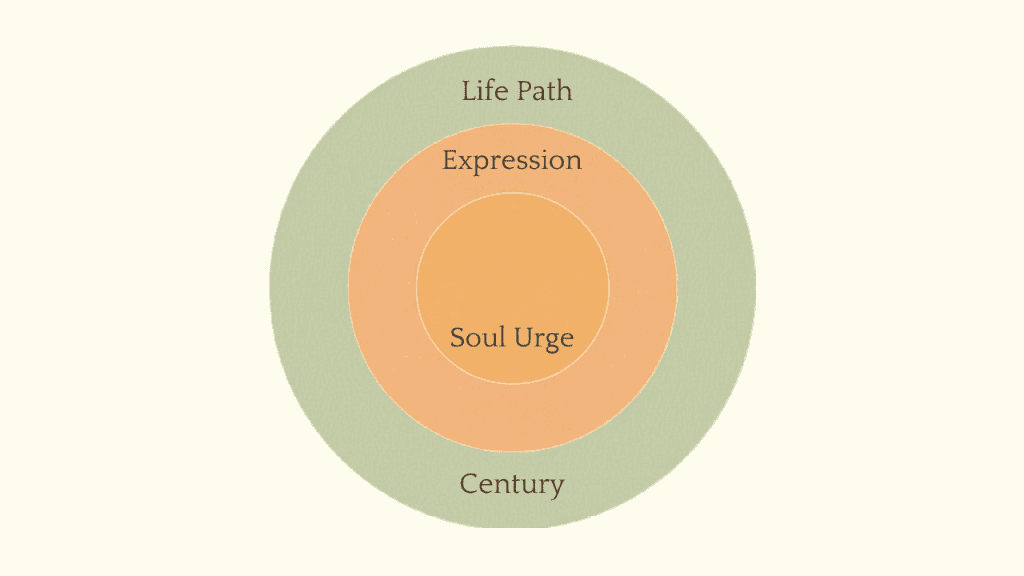
This is where most numerology content stops short—and where the real insight begins. A soul urge of 9 (service, universality) paired with a life path of 1 (independence, self-direction) creates a person who is simultaneously drawn toward both self-sufficiency and total devotion to others. Neither impulse is wrong. But operating from only one while suppressing the other produces the specific type of burnout and identity confusion these individuals describe repeatedly in their histories.
The value of identifying the tension between core numbers isn’t to resolve it permanently—it’s to stop being unconsciously controlled by it. When you can see the pull from both directions, you can make conscious choices about which one to honor in a given context. That’s not a solution. It’s something better: intelligent navigation.
Common Mistakes in Soul Urge Interpretation
- Using a nickname instead of the birth name. The full birth certificate name is the foundation. Nicknames reflect the personality you’ve portrayed; the birth name carries the original pattern.
- Treating the soul urge as destiny. It describes an orientation and a need—not a fixed outcome. People with identical soul urge numbers live very different lives because they make different choices about how to meet (or suppress) that underlying need.
- Reading only positive traits. Every soul urge number has a shadow—the distortion that emerges when the core need is either chronically unmet or pursued to an extreme. Ignoring this makes the reading useless for actual growth.
- Ignoring conflict between numbers. If your core numbers are pulling in different directions, that tension is the most important thing to understand. Don’t flatten it.
- Expecting instant clarity. The soul urge number is a starting point for reflection, not a complete answer. Sit with the description over time and see what it surfaces in your actual experience.
How to Actually Use Your Soul Urge Number
The most practical application is asking one question against every significant life area: Does this meet my soul’s urgent need, or is it actively working against it?
If your soul urge is 7 (depth, inner knowing) and your career requires constant surface-level social performance with no space for reflection, the low-grade dissatisfaction you feel isn’t neurosis or ingratitude. It’s information. Similarly, if your soul urge is 6 (love, nurturing) and you’ve built a life that’s professionally successful but privately emotionally barren, the career success doesn’t explain why nothing feels quite right.
This is the level at which soul-urge numbers offer genuine diagnostic value: not as prediction, but as a framework for recognizing the gap between what you’re doing and what you actually need to do to feel whole.
Ask yourself these questions as you sit with your number:
- In what areas of my life is this need being genuinely met?
- Where am I suppressing or contradicting this need—and what do I tell myself to justify that?
- What would it look like to honor this need more consciously in one specific area of my life right now?
The Limits of the System—and Why That’s Worth Saying
Numerology is not a validated empirical science. The Pythagorean assignment of numbers to letters is a human construction, and the interpretations of each number have evolved through tradition, not controlled research. A credible engagement with the soul urge number acknowledges this.
What makes these tools valuable isn’t mystical accuracy—it’s the quality of the questions they provoke. Carl Jung wrote that “until you make the unconscious conscious, it will direct your life, and you will call it fate.” Whether the mechanism is numerological or psychological is secondary to whether the reflection surfaces something real. For many people, it does.
Use the soul urge number the way a skilled therapist uses a projective test: not as a verdict, but as an invitation to look at something you might otherwise keep looking past.
Your Soul Urge Number Is a Map, Not a Mirror
The most important thing to understand about the soul urge number—and about numerology generally—is that it doesn’t describe who you are. It describes what you’re oriented toward. That’s a subtle but crucial distinction.
Who you are is shaped by everything: your choices, your history, your relationships, your culture, your willingness to examine yourself. The soul urge number describes one signal in that larger system—the deep pull of inner desire that operates even when you’re not aware of it.
Knowing your number doesn’t change what you want. But it can change your relationship to it. And that’s where the real work—and the real freedom—begins.
Soul Urge Numbers in Relationships—Why You Keep Attracting the Same Dynamic
Relationships are where soul urges and numbers become most visible—and most difficult to ignore. The way you love, what you need to feel loved, and what silently enrages you in a partnership are all shaped by this number in ways that are rarely conscious until something breaks down.
The most important principle: compatibility in numerology isn’t about finding a matching number. It’s about understanding what each person’s soul urge requires and whether those requirements can coexist without one person perpetually compromising themselves into resentment.
Two people with the same soul urge don't automatically thrive together. Two identical drives competing for the same resources—the same kind of love, the same type of control, the same depth of freedom—can be as corrosive as two entirely mismatched ones.
The more useful question is: does this person’s soul urge need create conditions that support or undermine mine? And vice versa?
How soul urge needs surface in intimate relationships
Soul urge 2 people, for instance, need to feel deeply seen and emotionally met. When partnered with a soul urge 1 who needs autonomous space and is uncomfortable with high-intensity emotional processing, neither person is wrong—but the 2 consistently feel abandoned, and the 1 consistently feels suffocated. Without a language for this dynamic, both partners tend to assume the problem is personal failure rather than a structural misalignment of needs.
Soul urge 5 (freedom) in relationship with soul urge 4 (stability and security) is another common collision. The 4 builds routines because routine creates safety. The 5 quietly suffocate inside the structure—and then explode or disappear in ways the 4 experience as a betrayal of everything they built together. The 5 was never trying to hurt the 4. They were choking.
Soul urge 6—the number most associated with love, nurturing, and domestic devotion—often ends up in relationships where they give so much more than they receive that resentment becomes the dominant undercurrent. The challenge for 6s is that their deep desire to be needed can unconsciously draw them toward people who need a lot of caretaking but struggle to reciprocate. This isn’t coincidence or bad luck. It’s the soul urge creating its own recurring pattern.
The relationship question worth asking
For any significant relationship—romantic, professional, or familial—these are the honest questions the soul-urge framework surfaces:
- Does this relationship create space for my core inner need to be expressed, or do I consistently suppress it here?
- Do I understand what this other person’s soul urge requires—and am I actually able to provide that without fundamentally contradicting my own?
- Where is the recurring conflict actually coming from—divergent values or divergent deep needs that we’ve never named?
Naming the need doesn’t guarantee resolution. But unnamed conflicts tend to loop indefinitely, collecting new surface-level grievances while the real issue goes untouched.
Common pairing tensions and natural harmonies
Soul urge 1 + Soul urge 2
tension pairing
1 needs autonomy; 2 needs deep union. Without deliberate communication, the 1 retreats, and the 2 interprets that as rejection. Workable — but only with real honesty about both sets of needs.
Soul urge 3 + Soul urge 7
natural harmony
3 brings expression and vitality; 7 brings depth and reflection. Each fills what the other lacks. The 3 can become the 7's bridge to the world; the 7 gives the 3's expression intellectual grounding.
Soul urge 4 + Soul urge 5
tension pairing
4 builds stability; 5 needs freedom from structure. The 4 experiences the 5 as unreliable. The 5 experiences the 4 as a cage. Requires significant negotiation around autonomy and commitment.
Soul urge 6 + Soul urge 9
natural harmony
Both are service-oriented, but at different scales. 6 focuses love inward on family and community; 9 orients toward humanity broadly. They share a fundamental orientation toward giving, which creates deep mutual recognition.
Soul urge 8 + Soul urge 2
tension pairing
8 is externally driven and impact-focused; 2 needs presence and emotional attunement. The 8 can be so absorbed in building that the 2's need for intimacy goes chronically unmet—a slow erosion.
Soul urge 1 + Soul urge 9
natural harmony
The 1's self-direction and the 9's altruism complement each other when the 1 channels independence toward meaningful contribution and the 9 avoids dissolving entirely into others' needs.
Soul Urge Numbers and Career: The Real Reason Some Work Feels Empty
Career dissatisfaction is one of the most common reasons people land on numerology. And the soul urge number offers a more precise diagnosis than most career personality tools—not because it predicts success, but because it identifies the internal conditions that make work feel meaningful versus numbing.
The critical point: a career can be objectively successful—high salary, status, competence—and still feel profoundly hollow if it systematically violates the soul’s urge or need. The soul urge doesn’t evaluate success from the outside. It evaluates it from the inside.
A key distinction: the soul urge doesn’t tell you which career to pursue. It tells you which conditions within any career path you need to feel genuinely engaged rather than just competent. A soul urge 7 can be a doctor, a professor, or a writer—but in each case, they’ll need depth of inquiry and time for reflection. Without those, the role burns them out regardless of how impressive it looks.
Career conditions by soul urge number
1-Needs: ownership, independence, and leadership without micromanagement. Thrives when they can direct their own work. Decays in hierarchical structures where every decision requires approval. Warning: may mistake busyness for autonomy — real autonomy is about decision-making, not workload.
2-Needs: genuine collaboration, harmony, and meaningful one-to-one connection. Thrives in partnership-based work, counseling, mediation, diplomacy, and team support roles. Decays in hyper-competitive, zero-sum environments. Warning: may sacrifice professional boundaries to keep peace, then burnout quietly.
3-Needs: creative expression and an audience. Thrives in roles that involve communication, design, performance, writing, teaching, or public-facing work. Decays in pure execution roles with no creative latitude. Warning: may flit between creative projects without finishing—depth brings more satisfaction than variety here.
4-Needs: structure, clear systems, and evidence that effort produces lasting results. Thrives in project management, architecture, engineering, accounting, legal, and operations. Decays in chaotic, improvisational environments. Warning: may choose stability-of-role over growth-of-self for too long.
5-Needs: variety, mobility, and freedom from fixed routine. Thrives in journalism, travel, entrepreneurship, sales, consulting, and anything with changing contexts. Decays in repetitive, fixed-format roles regardless of compensation. Warning: may leave good situations prematurely when novelty fades—ask whether it’s the job or the need for stimulation.
6-Needs: To visibly contribute to others’ well-being and to feel genuinely needed. Thrives in healthcare, education, social work, counseling, hospitality, and community-building roles. Decays in profit-only environments with no felt human impact. Warning: may overextend into caretaking at work and have nothing left for personal life.
7-Needs: deep inquiry, intellectual autonomy, and protected space for reflection. Thrives in research, philosophy, psychology, science, writing, analysis, or any work that rewards depth over speed. Decays in open-plan, constantly collaborative, output-measured environments. Warning: may retreat from necessary visibility, limiting the impact of their own insight.
8-Needs: scale, measurable impact, and the ability to build something significant. Thrives in entrepreneurship, executive leadership, finance, law, and large-scale project management. Decays in roles where effort has no visible result or no path to meaningful growth. Warning: may achieve the external markers of success while feeling internally empty—pact without meaning is a trap for 8s specifically.
9-Needs: Work with a genuine humanitarian dimension, at whatever scale. Thrives in nonprofit leadership, the arts, advocacy, international work, spirituality-adjacent fields, and holistic medicine. Decays in roles perceived as pointless or extractive. Warning: may idealize the mission and burn out trying to carry it alone—9s need structure and support, not just purpose.
11-Needs: inspiring, visionary work that allows spiritual and intuitive intelligence to operate. Thrives in leadership roles with a genuine higher purpose, coaching, teaching, healing, and creative fields. Decays in purely material, ego-driven environments. Warning: the heightened sensitivity that makes them gifted also makes harsh work cultures specifically damaging—environment matters enormously for 11s.
22-Needs: large-scale vision and the resources to build toward it. Thrives in architecture, urban planning, social entrepreneurship, institutional leadership, and anything with long-term legacy potential. Decays in small, enclosed, low-stakes roles. Warning: the size of the vision can feel crushing before the foundation is laid—22 years are needed to permit early-stage imperfection without abandoning the long game.
Soul Urge Numbers During Major Life Transitions
The soul urge number becomes most legible—and most urgent—during life transitions. Periods of significant change strip away the distractions that normally obscure the inner drive. What’s left, often uncomfortably, is the raw signal of what you actually need.
Understanding your soul urge number during a transition doesn’t tell you what to do next. But it tells you what internal conditions your next chapter needs to honor—and what conditions will quietly destroy it no matter how good it looks from outside.
Why transitions amplify soul urge pressure: In stable periods, people develop workarounds. The soul urge 5, who needs freedom, builds an organized life but takes adventurous solo holidays. The soul urge 2, who needs deep connection, manages a solitary career because they have a deeply nourishing marriage. A major transition—divorce, job loss, relocation, or grief—removes the workaround and leaves the underlying need fully exposed. This is why transitions feel so destabilizing even when the change itself was chosen or desired.
How each number type experiences major transitions
Soul urge 1 — the independence threat
Transitions that involve dependence on others—job loss, health crises, and forced relocation—are particularly destabilizing for 1s because they challenge the core need for autonomy. The 1’s recovery depends on finding any domain where they can reclaim agency, even small ones, while rebuilding. The mistake: refusing help entirely, which slows the process.
Soul urge 2—the disconnection threat
Transitions that rupture key relationships—divorce, bereavement, moving cities—are especially hard for 2s, whose sense of self is partly held in deep connection with others. The risk is collapsing entirely into grief without rebuilding social foundations. The recovery path for 2s specifically runs through new, genuine connection—not isolation while waiting to feel ready.
Soul Urge 3 — the silencing threat
When major life transitions consume all available bandwidth—new parenthood, grief, career collapse—the 3’s expressive outlet is often the first thing abandoned. This creates a particular flatness that 3s mistake for depression but is sometimes simply the absence of creative output. Even minimal creative expression during transition helps 3s maintain psychological coherence.
Soul Urge 4—the instability threat
Upheaval of any kind lands hardest on 4s, who need stable foundations to feel psychologically grounded. The instinct during transition is to rebuild structure immediately—sometimes prematurely. The 4’s real work in transitions is tolerating necessary uncertainty long enough to build something genuinely right rather than just something fast.
Soul urge 5—the entrapment threat
Transitions that involve new constraints—caregiving responsibilities, major financial pressure, geographic limitations—trigger the 5’s deepest fear: being trapped. The 5 often respond by either fleeing (which may be appropriate) or creating chaotic freedom as a reaction, which damages what they’ve built. The anchor: finding genuine micro-freedoms within constrained circumstances.
Soul urge 6, 7, 8, 9—brief notes
6s in transition often overfunction as a way of managing anxiety—doubling care for others to avoid processing their own upheaval. Sevens retreats into analysis and inner life, which is natural but can delay necessary action. 8s try to manage their way through transition with strategy alone, often bypassing the emotional processing that transitions require. 9s grieve transition ideologically—the lost world represented something; the new one must find its meaning quickly for the 9 to stabilize.
The universal principle across all numbers
Every soul-urge number has a signature way of mishandling transition—usually by defaulting to its core drive in an unbalanced form. The one becomes isolated in their autonomy. The 2 become enmeshed in others’ needs. The 4 rigidify prematurely. The 8 overstrategizes. Recognizing the default response is the first step toward a more conscious one.
Transitions are not interruptions of your life. They are the moments when your life is most honestly asking you what you actually need. The soul urge number gives you a language for that question—if you’re willing to sit with the answer.
Bringing It All Together: How to Live With Your Soul Urge Number
By now, you have a complete picture of what the soul urge number is, what it reveals, and how it operates across relationships, career, and life transitions. The question isn’t whether you find it credible as a mystical system. The question is whether the reflection it surfaces is honest—and what you’re willing to do with what it shows you.
Here is the summary of what this system, at its best, offers:
- A language for the inner drives that shape your choices before conscious reasoning gets involved.
- A diagnostic for chronic dissatisfaction in careers and relationships that otherwise seem inexplicably wrong.
- A framework for understanding not just what you want but also what you need—and the difference between those two things is often where the most important self-knowledge lives.
- A way of naming the tension between different core numbers in your chart—especially when your soul urge and life path pull you in genuinely different directions.
The soul urge number doesn’t resolve anything. It illuminates. Resolution requires the harder work: choosing, consistently, to honor what you’ve learned about yourself even when it’s inconvenient, even when it means disappointing someone, and even when the easier path is to suppress the need one more time.
Most people suppress their soul urge for years without realizing it. They build lives around what is expected, what is practical, and what is approved of—and then reach a point where the suppression has produced enough accumulated dissatisfaction that they can no longer ignore the gap between who they are and how they’re living.
That gap has a name. The soul urge number is one way of reading it.
Three final reflections worth carrying forward
First: knowing your soul urge number is not the same as understanding it. Understanding comes from watching it operate in your actual life over time—in the decisions you avoid, the patterns that repeat, the moments of genuine aliveness that don’t fit the narrative you’ve told yourself about what you want.
Second: your soul urge is not an excuse. It is not a reason to abandon commitments, harm relationships, or act in ways that conflict with your ethics. It is a signal—one input among many in the complex process of becoming who you are capable of being. Honoring a need doesn’t mean acting on it immediately and without wisdom.
Third, the soul’s urge number points inward. Every number, in its healthiest expression, is not about acquiring something from the external world—it is about becoming more fully what you already are at your core. Soul urge 8 is not fundamentally about accumulating power. It’s about the internal experience of mastery and meaningful impact. Soul urge 2 is not fundamentally about dependency. It’s about the profound human experience of genuine union.
The number describes an inner orientation. What you build from it—the quality of your relationships, the integrity of your work, the depth of your self-knowledge—that part is entirely yours.
FAQs
What is a soul urge number in numerology?
The soul urge number, also called the heart’s desire number, is one of the five core numbers in numerology. It is calculated from the vowels in your full birth name and is said to reveal your deepest inner desires, emotional needs, and the motivational core that drives your choices—often beneath conscious awareness. It describes not what you do well or what your life trajectory is, but what you fundamentally need to feel fulfilled.
How do I calculate my soul urge number?
To calculate your soul urge number, write your full birth name and identify every vowel (A, E, I, O, U—and Y when it functions as a vowel). Assign each vowel its Pythagorean numerical value: A=1, E=5, I=9, O=6, U=3, Y=7 (when applicable). Add all values together and reduce to a single digit by summing the digits of the total. Stop if you reach 11, 22, or 33, as these are master numbers that are not reduced further.
What does soul urge number 7 mean?
Soul urge number 7 indicates a deep drive toward inner truth, wisdom, and knowledge. People with this number have a fundamental need for depth—in their understanding, their relationships, and their work. They tend to be introspective, analytical, and spiritually curious. The challenge for 7s is a tendency to retreat into analysis and inner life at the expense of real-world engagement, which paradoxically prevents them from answering the questions they’re most driven by.
What is the difference between soul urge number and life path number?
The life path number (derived from your birth date) describes the overarching theme of your life journey—the terrain you’re navigating. The soul urge number (from the vowels in your birth name) describes your deepest inner desires and emotional needs. The life path is about what you’re meant to engage with; the soul urge is about why you engage with anything at all—your internal motivational core. They often pull in different directions, and that tension is some of the most valuable information in a full numerology profile.
What does soul urge number 11 mean?
Soul urge 11 is a master number, meaning it carries amplified energy and heightened challenges. People with this number have a deep drive toward spiritual understanding, intuition, and inspiring others. They often feel called to something larger than ordinary ambition. The challenge is that this sensitivity and elevated awareness, when not grounded in daily life, can produce anxiety, a feeling of not belonging, and difficulty converting vision into practical action.
Is the soul urge number the same as the heart’s desire number?
Yes. “Soul urge number” and “heart’s desire number” are two names for the same calculation in numerology. Both refer to the number derived from the vowels in your full birth name, and both describe your innermost desires, emotional drives, and deepest psychological needs. Different numerology traditions use different terminology, but the method and meaning are identical.
What does soul urge number 6 mean?
Soul urge number 6 reflects a deep orientation toward love, nurturing, and responsibility. People with this number feel most fulfilled when they are genuinely contributing to the well-being of others—in family, community, or creative work that serves people. Their significant challenge is learning the difference between loving and managing: the 6’s desire to care can become controlling when driven by anxiety rather than genuine generosity.
Can your soul’s urge number change over time?
No. Because the soul urge number is derived from the vowels in your birth name—which never change—the number itself is fixed. However, your understanding of what it means and your ability to consciously work with the underlying drive it describes will develop significantly over a lifetime. Many people find that their soul urge number becomes more recognizable and useful as they gain more self-knowledge, not because the number changed, but because they changed.