The phrase sounds almost poetic—dark night of the soul. And that’s exactly the problem. When you’re inside it, it doesn’t feel like poetry. It feels like collapse. Like you’ve lost access to something you can’t name, and no amount of meditation, journaling, or motivational content touches the emptiness.
Here’s what most articles won’t say directly: the dark night of the soul isn’t a malfunction. It’s a demolition. Something has to be torn down before something truer can be built—and the discomfort of that process is the point, not a side effect.
This article covers the real symptoms, the actual stages, the psychology behind what’s happening, the mistakes that make it worse, and what it genuinely looks like to come out the other side.
What Is the Dark Night of the Soul? (And What It Isn’t)
The concept originates with St. John of the Cross—a 16th-century Spanish mystic and poet who wrote La noche oscura del alma. In his framework, the dark night was the soul’s forced journey through profound spiritual aridity toward divine union. The key word is “forced.” This wasn’t a retreat or a spiritual discipline he chose. It was something that happened to him—a stripping away of every consolation, every comfortable spiritual experience, every sense of God’s presence, until only the raw self remained.
Contemporary psychology and transpersonal traditions have adopted the concept and broadened it. Today, “dark night of the soul” describes any extended period of profound inner crisis where your existing identity structure—the beliefs, roles, meanings, and self-narratives that told you who you are—begins to come apart.
The Modern Misunderstanding
People use the phrase loosely—for a hard month, a rough breakup, a period of anxiety. That’s not this. The genuine dark night is marked by the dissolution of your meaning-making system. Not sadness. Not stress. The collapse of the framework through which you understood yourself and your place in the world. That is a categorically different experience.
- It typically follows or coincides with a spiritual awakening, major disillusionment, or identity-level disruption
- Even at its worst, there’s often a strange subterranean knowing—a sense that something essential is at work, even if you can’t name it
- It tends to intensify creative and symbolic inner life (vivid dreams, unusual perception, heightened sensitivity), rather than flatten it
- Depression makes the future feel hopeless. The dark night makes it feel unknowable—different things entirely
- When genuinely traversed, it tends to result in a more integrated, grounded identity—not just recovery to baseline
⚠ Important
The two can co-exist. A dark night experience can trigger genuine clinical depression. If symptoms include complete functional breakdown, dissociation, or thoughts of self-harm, professional support is not optional. Always rule out medical causes with a qualified clinician.
The 10 Core Symptoms of the Dark Night of the Soul
These symptoms aren’t a checklist—they’re a constellation. Not everyone experiences all of them, and they don’t always appear in sequence. What distinguishes the dark night is the quality of the experience: a deep, structural unraveling rather than circumstantial unhappiness.
01
Loss of meaning
Things that once structured your life—work, relationships, beliefs—feel hollow. Not from boredom, but from ontological vertigo.
02
Spiritual dryness
If you had a spiritual practice, it stops working. Prayer, meditation, and ritual—the channel goes silent mid-transmission.
03
Identity fragmentation
You don’t know who you are anymore. The roles you played—the achiever, the believer, the caregiver—stop fitting.
04
Withdrawal from others
Not antisocial hostility—a deep, bone-level need for solitude. Social performance costs more than it returns.
05
Emotional volatility / numbness
Waves of unexplainable grief or shame alternating with a flat, cotton-wool emotional numbness.
06
Anhedonia
Things you loved—music, creative work, food—lose their color. The world becomes thin and slightly unreal.
07
Heightened perception
Paradoxically, moments of startling clarity or beauty cut through the fog. The dark night has its own strange light.
08
Vivid inner life
Dreams become charged and symbolic. The unconscious speaks loudly when the conscious self-narrative breaks down.
09
A strange undercurrent of knowing
Even at the worst, many people report a quiet sense that something purposeful is happening—even without words for it.
10
Existential urgency
Not philosophical curiosity. Lived, urgent questions: What is this all for? What do I actually believe? Who am I without the story?
The 5 Stages of the Dark Night of the Soul
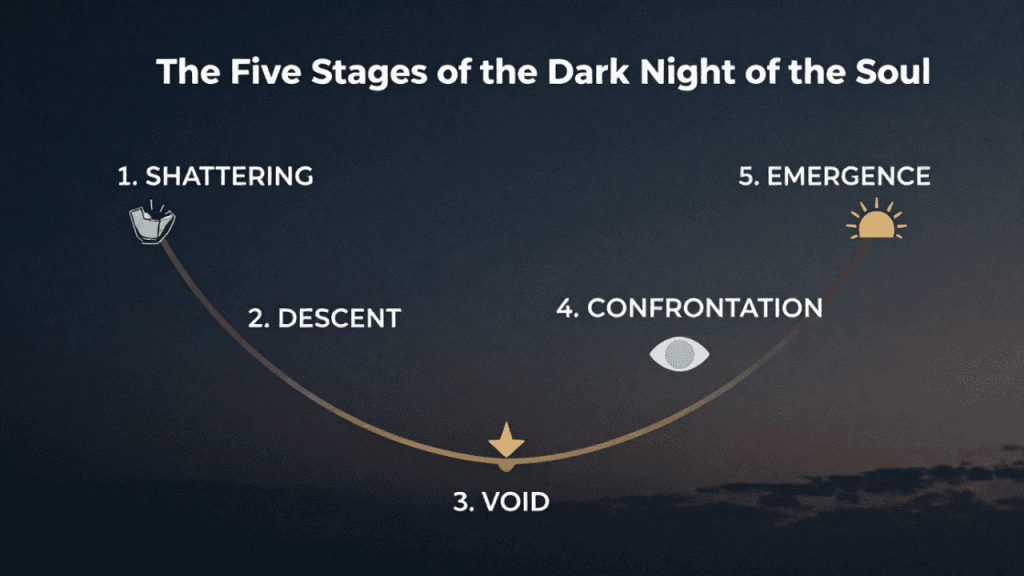
See the Stages Visual tab for a structured breakdown. Here’s the narrative arc:
Stage 01
The Shattering
Something breaks—a loss, a disillusionment, or a spiritual experience that reveals the scaffolding of your life was built on assumptions that no longer hold. The trigger is different for everyone: a death, a betrayal, a moral injury, or a major achievement that lands completely hollow. What's consistent is the feeling that the ground has dropped out. You cannot simply absorb this into your existing worldview. It breaks the container.
Stage 02
The Descent
The old self begins coming apart in earnest. This is where most of the core symptoms intensify—anhedonia, identity confusion, spiritual dryness, and withdrawal. You try to hold things together using tools that worked before: willpower, self-help frameworks, spiritual practices, and professional achievement. They don't grip. This is not failure. This is the descent doing exactly what it needs to do. The old structures must loosen before new ones can form.
Stage 03
The Void
The hardest and most important stage. The old identity has dissolved enough that there's nothing yet to replace it. Pure emptiness. Pure not-knowing. Buddhist Śūnyatā, Christian kenosis, Sufi fana—spiritual traditions across history describe something functionally identical here. This is the stage most people escape through distraction, substances, relentless productivity, or a premature new identity. Escaping it delays the process. The void is not a problem. It is the crucible.
Stage 04
The Confrontation
What begins to emerge from the void is honesty. Stripped of your previous identity's filters, you start to see with unusual clarity what you actually value, what you actually believe, and what was genuinely yours versus what you inherited and performed. This stage is painful and clarifying in equal measure. Old self-narratives—often self-protective ones—become very hard to maintain. Truth-telling becomes less optional.
Stage 05
The Emergence
Not a return to who you were—a formation of something more integrated. People who have genuinely moved through a dark night describe a quieter, more grounded relationship with life. Less performance. More authenticity. A different—earned—relationship to suffering. The emergence is rarely dramatic. It tends to arrive as a gradual settling, a renewed capacity to engage, and a curious, unexpected gratitude for the whole process—even the worst of it.
Note on timing
There is no standard timeline. Some people move through these stages in months. For others it takes years. Duration depends on how deeply the previous identity structure was embedded, how much resistance is offered to the process, and what external support is available.
The dark night moves—not linearly, but directionally. You don’t simply feel bad and then feel better. Something is genuinely dismantled, and something genuinely different emerges. The five stages below describe that arc. They are not rigid phases but recurring thresholds most people cross in roughly this sequence.
What’s Actually Happening Inside You—The Psychology
Carl Jung described the essential process as individuation—the lifelong movement toward psychological wholeness that requires integrating the shadow, the disowned, denied, and repressed dimensions of the self. The dark night is, in Jungian terms, the ego’s forced confrontation with everything it has avoided. It’s not punishment—it’s integration under pressure.
Viktor Frankl adds another lens through logotherapy: his observation, formed in the most extreme conditions imaginable, was that human beings can endure almost any how if they have a sufficient why. The dark night is precisely the experience of your why collapsing—and the agony of waiting for a new one to form. This isn’t weakness. It’s the cost of being a meaning-making creature whose meaning has failed.
Contemporary neuroscience offers a third framework. Research into psilocybin-induced ego dissolution has found that the brain’s default mode network—the neural hub of identity, self-narrative, and self-referential thought—shows striking disruption during mystical and ego-dissolution experiences. The self-model becomes temporarily destabilized. Some researchers suggest this destabilization is precisely what allows the formation of a less rigid, more adaptive self-structure afterward. The suffering is real. So, apparently, is the recalibration.
Research note
Carhart-Harris et al. (2014), "The entropic brain: A theory of conscious states informed by neuroimaging research with psychedelic drugs"—Frontiers in Human Neuroscience—documents the neural correlates of ego dissolution. The parallels with mystical crises are striking.
Common Mistakes People Make (That Extend the Dark Night)
- Treating it as depression to be fixed. The instinct to medicate the experience into silence is understandable. But numbing the dark night is not the same as moving through it. The process requires consciousness, not anesthesia.
- Spiritual bypassing. Trying to meditate, affirm, or gratitude-journal your way out. The dark night is immune to positivity. It requires honesty—which is precisely what most spiritual practices, when misused, help you avoid.
- Weaponizing productivity. Busyness is the most socially acceptable form of avoidance. The dark night slows you down deliberately. Fighting the pace intensifies the friction.
- Pathologizing every symptom. Not every period of profound suffering is a disorder. Some suffering is generative. The inability to distinguish the two is itself a cultural problem.
- Complete isolation. Withdrawal is natural; full isolation is dangerous. Some human contact—even minimal, even with just one trusted person—remains essential.
- Forcing a timeline. There is an intense desire to be “done.” People around you want you back. You want yourself back. But the process has its own intelligence and its own pace. Pressure to emerge faster almost always delays things.
How to Move Through It, Not Around It
- Stop fighting the emptiness. The void is not a detour. It is the process. Sitting with it—even for short periods, without trying to resolve it—is the most counterintuitive and necessary act.
- Reduce the noise. Limit social media, numbing content, and productivity theater. The dark night requires a quieter internal environment than modern life typically allows.
- Engage with symbolic thinking. Journaling, dreams, art, poetry—the language of this phase is symbolic and associative, not analytical. Analytical tools won’t get traction here.
- Find a container. A therapist familiar with transpersonal psychology, a Jungian analyst, or a trusted spiritual director—someone who understands transformative suffering and won’t pathologize or rush it.
- Read accounts of people who’ve been through it. St. John of the Cross. Thomas Merton. Viktor Frankl’s and Eckhart Tolle’s early writings. Not to copy their path, but to remember that this is a human experience—one with a long history and a real other side.
- Tend to the body. Walk. Sleep carefully. Eat real food. The body is your anchor when identity dissolves. This is not optional self-care. It is structural.
- Allow grief. Much of the dark night is unmourned grief—for the self you were, the certainties you held, and the life that made sense. Let it be grief. Name it that.
Self-Reflection Questions Worth Sitting With
- What did I believe about myself before this started—and do I still believe it?
- What am I most afraid of losing if I release this version of myself?
- What has become impossible to pretend anymore?
- Is there something I’ve known for a long time that I’ve been avoiding acting on?
- What would the most honest version of my life actually look like right now?
Key Takeaways
- The dark night of the soul is not casual sadness—it is the dissolution of your existing identity and meaning structure.
- It differs from clinical depression in character, trajectory, and outcome—though the two can coexist.
- The 10 core symptoms form a constellation, not a checklist. The quality of experience matters more than the list.
- Psychologically, it maps to Jungian individuation, Frankl’s logotherapy, and emerging neuroscience around ego dissolution.
- The most common mistake is trying to fix or escape it. The only genuine path is through.
- What emerges on the other side is not a return to the old self—it is something quieter, more grounded, and more honest.
What the Other Side Actually Looks Like
People who have genuinely traversed the dark night—not medicated it into silence or distracted themselves past it, but actually sat with it and moved through it—tend to describe the same things on the other side.
Less performance. More presence. A quieter relationship with certainty. A reduced need for external validation. A strange, earned equanimity toward suffering—not because they no longer feel pain, but because they’ve learned it isn’t fatal.
They often say that who they were before the dark night was real—but partial. And who they became after were not more comfortable but more true.
That is not a small thing. It is, in fact, the whole point.
FAQ
How long does the dark night of the soul last?
There is no fixed timeline. Some people experience it for weeks; for others it lasts years. Duration depends on how deeply the previous identity structure was embedded, how resistant the person is to the process, and what external support is available. Trying to accelerate it typically extends it.
Is the dark night of the soul a spiritual emergency?
It can be. Transpersonal psychology distinguishes between spiritual emergence (gradual transformation) and spiritual emergency (acute crisis requiring immediate support). If symptoms include complete functional breakdown, dissociation, psychosis-like experiences, or thoughts of self-harm, professional support is essential—not optional.
Can you have a dark night of the soul without being religious?
Absolutely. The religious framing is historical—the core experience is human. Secular versions often involve the collapse of career identity, ideological disillusionment, or the failure of a meaning system built around achievement, status, or relationships. The language of the soul is optional. The experience is not.
What triggers the dark night of the soul?
Common triggers include a spiritual awakening that destabilizes prior beliefs; significant loss (death, divorce, or career collapse); moral injury; achieving a major goal that turns out to feel empty; and mid-life identity reckonings. What’s consistent is that the trigger reveals an inadequacy in the existing meaning structure—something that can no longer be ignored.
Is the dark night of the soul the same as a spiritual awakening?
They are related but distinct. A spiritual awakening often precedes or triggers the dark night. The awakening reveals something true that the existing identity cannot accommodate—and the dark night is the painful dismantling that follows. The awakening opens the door. The dark night walks you through it.
How is the dark night of the soul different from burnout?
Burnout is primarily a depletion of resources—energy, motivation, capacity—typically caused by chronic overextension. It resolves with rest, recovery, and boundary-setting. The dark night is a crisis of meaning and identity, not depletion. Rest alone doesn’t resolve it. The two can overlap, but burnout recovery looks different from dark-night navigation.
Can therapy help with the dark night of the soul?
Yes—but the type of therapy matters. Cognitive behavioral therapy (CBT) is excellent for depression and anxiety management but may not address the identity-level dissolution of the dark night. Depth psychology, Jungian analysis, transpersonal therapy, or working with a therapist familiar with existential and spiritual crisis tends to be more appropriate. The goal isn’t to eliminate the experience—it’s to navigate it without getting stuck.