How to Find Your Life Purpose: A Practical Guide to Discovering What Matters

“What am I supposed to do with my life?”
You’ve probably asked yourself this on a Tuesday afternoon that had no business feeling existential. Maybe it hit while you were sitting in traffic, or scrolling past someone else’s announcement about their “dream job,” or lying awake doing math on how many years you have left to figure this out.
Here’s what nobody tells you before you go looking for an answer: Most people who ask this question are actually asking a different one underneath it. They’re not asking what their purpose is. They’re asking why they don’t already know.
That’s a fair question, and the honest answer is that you were probably taught to expect purpose to arrive as one dramatic realization—a calling, a sign, a moment where everything clicks. For most people, it doesn’t work that way. Purpose tends to show up in fragments, over time, through paying attention to what you already do, feel, and care about, then testing it against real life instead of just thinking about it harder.
This guide won’t hand you a destiny. It will give you something more useful: a way to investigate what matters to you and a next step you can actually take this week.
Before we get into the how, it helps to be clear on the what—if you haven’t already, what is life’s purpose? is worth reading first, since this guide builds directly on it.
What Does Life Purpose Really Mean?
Say the word “purpose” out loud, and it tends to drag some heavy company with it: destiny, calling, mission, and legacy. That’s part of why the question feels so loaded. You’re not just trying to answer it—you feel like you’re auditioning for the rest of your life.
Strip away the drama, and purpose is simpler than that. The American Psychological Association describes it as a person’s sense of a goal or aim in living—a direction that organizes how you spend your time, attention, and effort. Researchers who study purpose as a psychological construct have spent real effort trying to define and measure it precisely, partly because the popular version of the word has become almost meaningless from overuse.
Used carefully, life purpose means something closer to this: a meaningful direction that shapes what you choose to do with your time, your abilities, and your attention—not a single fixed answer you’re missing. That direction can run through your work. It doesn’t have to live only there.
Purpose isn’t your passion.
Passion is enthusiasm—a pull toward something. You can be passionate about rock climbing without rock climbing meaning anything about who you are or what you want to contribute. Purpose is broader and steadier; it’s less about how excited something makes you and more about why it matters.
Purpose isn’t your career.
Your job can express your purpose. It doesn’t have to hold all of it. Someone can find real purpose through mentoring a junior colleague, raising their kids with intention, or showing up for a community group every week—none of which will ever appear on a résumé.
Purpose isn’t a goal.
A goal has an endpoint. “Publish a book” is a goal—you either do it or you don’t. Purpose is what decides which goals are worth setting in the first place. “I want to help people think more clearly” doesn’t end when one book gets published; it just picks the next project.
Purpose isn’t one perfect calling you’re supposed to identify and lock in.
You don’t need to find the one true mission that was somehow waiting for you before you were born. Most people who report a strong sense of purpose didn’t discover it in a single moment—they built it, adjusted it, and sometimes replaced it, more than once.
Purpose isn’t constant happiness.
This might be the most important distinction here, because it’s the one that quietly convinces people they’re on the wrong path. Meaningful things are often demanding, tedious, or flat-out hard. Raising a child with purpose includes 4 a.m. wake-ups. Building something you believe in includes long stretches where it doesn’t feel exciting at all. If you’re waiting to feel good every day as proof you’ve found it, you’ll talk yourself out of things that actually matter.
Why Is Finding Your Life Purpose So Difficult?
If purpose is just “a meaningful direction,” why does it feel like trying to catch fog?
You think there’s one right answer.
Somewhere along the way, you picked up the idea that everyone else has already found their purpose and you’re the one running behind. That’s rarely true—most people are improvising more than they let on. The belief that a single correct answer is waiting to be discovered puts pass/fail pressure on a process that was never supposed to work that way.
You’ve confused purpose with passion.
“Follow your passion” is popular advice with a hidden flaw: it assumes you already have a passion sitting there, fully formed, waiting to be followed. Most people don’t. Interest is usually the result of exposure and practice, not the cause of it. Ask a smaller question instead—not “What am I passionate about?” but “What do I keep paying attention to, and what could I do with that?”
You’re waiting for certainty before you’ll act.
This is the trap that keeps people stuck for years. The assumption is that clarity comes first and action comes second. In practice it’s usually the reverse: you act, you notice how it feels, and the clarity shows up afterward as a byproduct of the experience—not a precondition for it.
Other people’s expectations are loud.
Family, culture, comparison, and a decade of social media have all been quietly voting on what your life should look like. Sometimes the real question isn’t “What should I do with my life?”—it’s “Which parts of what I’m currently pursuing are actually mine, and which parts did I inherit without noticing?”
Your life has changed, and your old direction hasn’t caught up.
A direction that made complete sense at 24 can feel hollow at 38, not because you were wrong then, but because you’re not the same person now. New responsibilities, relationships, and experiences change what matters to you. That’s not a personal failure. It’s what growing up looks like.
You’re asking a question that’s too big to answer.
“What should I do with the rest of my life?” is not a question anyone can reasonably answer on a Tuesday night. Shrink it. Try: “What matters enough for me to explore next?” That version is answerable—and answering it, repeatedly, is basically what having a purpose looks like in practice.
Stop Searching for One Perfect Answer—Look for Clues
Here’s a shift worth making before anything else: stop treating this like a search for a hidden object, and start treating it like an investigation.
Instead of asking, “What is my purpose?” ask, “What evidence already exists in my life about what matters to me?”
You have more of this evidence than you think. Certain problems bother you more than they seem to bother other people. Certain conversations stay with you longer than they should. Certain kinds of help you find yourself offering without being asked. None of this is your purpose, exactly. It’s a clue.
And clues are not conclusions. This distinction matters more than almost anything else in this guide, so it’s worth being blunt about it: enjoying photography does not mean you’re supposed to become a photographer. Being the person everyone asks to organize things doesn’t mean your purpose is management. Caring about animals doesn’t obligate you to become a veterinarian. A single clue is interesting. A pattern across several clues, tested against real experience, is what’s actually worth building on.
The Purpose Discovery Loop
This is the framework we use at PurposeUnfolded, and it’s worth naming clearly because it’s the backbone of everything below:
NOTICE → REFLECT → CONNECT → EXPERIMENT → LEARN → REFINE → ACT
A note on what this is and isn’t: this is an original reflection framework, not a clinically validated psychological instrument. It won’t diagnose you or hand you a score. What it does is give structure to a process that otherwise feels shapeless—turning scattered self-awareness into something you can actually act on.
1. Notice what keeps showing up.
Before deciding what your purpose is, look at your actual life—not the version of it you’d describe in a job interview, the real one. What topics do you keep returning to in conversation, even when nobody asked? What kind of problems do you notice that other people seem to walk right past? What makes you lose track of time? What situations leave you quietly frustrated because nobody is fixing them?
Try this for real: for seven days, keep a running note on your phone. Every time something catches your attention—a topic, a frustration, a moment you felt useful—write one line. Don’t interpret it yet. You’re not building an argument. You’re collecting raw material. By day four, most people are surprised by how repetitive their own list is.
2. Reflect on what matters.
Once you have some raw observations, go one layer deeper and ask why. Say you noticed you enjoyed helping a coworker think through a decision—fine, but why did that stick with you? Because you like being useful? Because you enjoy untangling complicated problems? Because you value someone else’s growth more than you value being the smartest person in the room?
The behavior is the surface. The reflection happens underneath it, across five areas:
- Values—what matters enough to influence your actual decisions, not just your stated opinions
- Strengths—abilities you’ve developed, whether or not they came naturally
- Meaning—experiences that felt worthwhile independent of anyone noticing
- Interests—subjects you return to without being asked
- Contribution—who or what you’d genuinely like your effort to benefit
You’re not trying to produce a tidy answer here. You’re trying to notice a pattern.
3. Connect the clues
Now put the pieces next to each other and see what they add up to. Say your notes show you enjoy explaining complicated ideas simply, people frequently ask you for advice, you value learning, and you care about people feeling less confused about their own lives. Individually, none of that means much. Together, it starts to suggest something—maybe you enjoy turning what you learn into something that helps other people make sense of their own situation.
That’s not your purpose. It’s a hypothesis. Treating it as anything more than that—a declaration, a destiny—is exactly the trap that made this feel so hard in the first place. Treating it as a hypothesis is what gives you permission to test it without staking your entire identity on the outcome.
4. Run a small experiment.
This is where most self-help content quietly stops, and it’s also where the real information lives. Don’t quit your job over a hunch. Don’t reorganize your whole life around a pattern you noticed in a week of notes. Test it, small and cheap.
Think you might enjoy teaching? Tutor one person, once. Think you might care about a cause? Volunteer for an afternoon, not a year. Curious about a career? Have one real conversation with someone doing the actual job—not the LinkedIn version of it, the Tuesday-at-4pm version. Think you might like building things? Build one small, unglamorous version of the thing.
The goal isn’t to succeed. The goal is to generate information you couldn’t get from thinking alone.
5. Learn from the experience.
After the experiment, resist the urge to just ask, “Did I like it?” That question is too blunt to be useful. Ask instead: What part gave me energy, specifically? What part drained me? Did I enjoy the actual activity, or only the idea of it beforehand? Would I want to get better at this, even through the boring parts? What did I misjudge going in?
This is often where people discover something more useful than confirmation. You might learn you don’t actually enjoy teaching—but you love explaining things clearly, which points somewhere else entirely: writing, coaching, content, and training. The experiment didn’t fail. It corrected your aim.
6. Refine your direction.
Clarity often comes less from finding what fits and more from removing what doesn’t. “I like helping people, but not in a customer-service structure” is progress. “I love creating, but I don’t want to do it completely alone” is progress. “I care about this cause, but I don’t want it to be my job” is progress. None of these feel like triumphant discoveries. They’re all still useful—arguably more useful than a vague sense that something “seems right.”
7. Act—then loop again
Finally, choose your next meaningful step. Not the next twenty years. The next one. That might be learning a specific skill, having a particular conversation, starting a small project, or setting a boundary you’ve been avoiding. Whatever it is, take it—and then the loop starts again, informed by what you just learned. This isn’t a process you complete once. It’s the process you keep running, at a smaller and smaller scale, for the rest of your life.
Five Clues That Can Help You Explore Your Purpose
The loop tells you how to explore. These five categories tell you what you’re actually looking for while you do it.
Energy clues
What repeatedly holds your attention without being forced? This isn’t the whole story, because some genuinely meaningful things are boring or difficult. But repeated, voluntary interest is still worth noting.
Value clues
What matters enough that you’ll make an inconvenient choice to protect it? Freedom, honesty, creativity, stability, service, independence—whatever it is, values explain why certain directions feel important and others feel hollow even when they look impressive on paper.
Strength clues
What do you do well, or what have you built through repetition? A strength doesn’t have to be innate. And a strength alone isn’t a purpose—plenty of people are good at things they have no interest in continuing. Strength gets interesting when it overlaps with something you value and something you’re willing to keep doing.
Meaning clues
When has something felt worthwhile independent of whether anyone was watching? Meaning shows up in unglamorous places more often than people expect: explaining something clearly, sitting with someone through a hard week, and fixing a small thing that was quietly broken.
Contribution clues
Who or what do you actually want to help? This doesn’t require an audience. Helping one person consistently counts. Improving one process at work counts. You don’t need a global impact to have a real one.
What Your Purpose Doesn’t Have to Be
Before going further, it helps to clear away some assumptions that are probably making this harder than it needs to be.
Your purpose doesn’t have to be your career. It doesn’t have to be your biggest achievement. It doesn’t have to sound impressive when you say it out loud. It doesn’t have to help millions of people—helping one person well is not a smaller version of purpose; it’s a complete one. It doesn’t have to be something you knew as a child, something dramatic, or something that never changes.
And—worth repeating—it doesn’t have to make you happy every single day. If your standard for “on the right path” is constant enjoyment, you will abandon the right path the first time it gets hard, which is usually within the first month.
15 Questions to Help You Explore Your Life Purpose
Don’t answer all of these in one sitting. Read through them and notice which ones actually produce a reaction—a slight discomfort, a memory, an “oh.” Those are the ones worth sitting with.
Your past
- What experiences have shaped who you are, for better or worse?
- When have you felt most engaged with being alive?
- What problems have you repeatedly wanted to solve, even uninvited?
Your values
- What matters enough that you’d protect it even when it costs you something?
- What qualities do you want your life to actually express, not just admire in others?
- What would you regret ignoring?
Your strengths
- What do people naturally come to you for?
- What have you gotten good at through sheer repetition?
- What kind of difficulty do you find yourself willing to sit with?
Your meaning
- What experiences have felt genuinely worthwhile, whether or not anyone noticed?
- What makes an ordinary Tuesday feel like it mattered?
Your contribution
- Who do you actually want to help—not who you think you’re supposed to want to help?
- What problem would you like to make even slightly better?
- What do you want your effort, over a lifetime, to have stood for?
- If you could improve one part of life for other people, what would you pick?
What If You Don’t Know What You’re Passionate About?
This is more common than the internet lets on, and it’s not a sign that something is wrong with you.
Stop starting with passion. Start with curiosity—a noticeably lower bar. Ask what you’re willing to spend an afternoon investigating, not what sets your soul on fire. Then go do the thing.
Curiosity, followed through, tends to become interest. Interest, practiced, becomes competence. Competence tends to produce confidence, and somewhere in that sequence, contribution shows up—not because you found your passion, but because you kept showing up long enough for one to form.
If you’re waiting for a feeling before you’re allowed to start, you might be waiting for something that was only ever going to arrive after you started.
Your Purpose Doesn’t Have to Be Your Career
This deserves its own section because it’s one of the most common ways people talk themselves into unnecessary despair: they assume that if their job doesn’t feel like their calling, they must not have found their purpose yet.
Your career can express your purpose. It doesn’t have to carry the whole weight of it.
Picture someone working in accounting—a job that rarely gets described as anyone’s “calling.” Their purpose might actually be running through creating financial stability for their family, mentoring the newer hires nobody else bothers training properly, or being the one person in the office who does things honestly when it would be easier not to. None of that shows up in the job title. All of it is real.
The more useful question isn’t “What job is my purpose?” It’s “What kind of contribution do I want my life to make, and where—not just at work—can I actually express that?”
Purpose vs. Passion vs. Goals
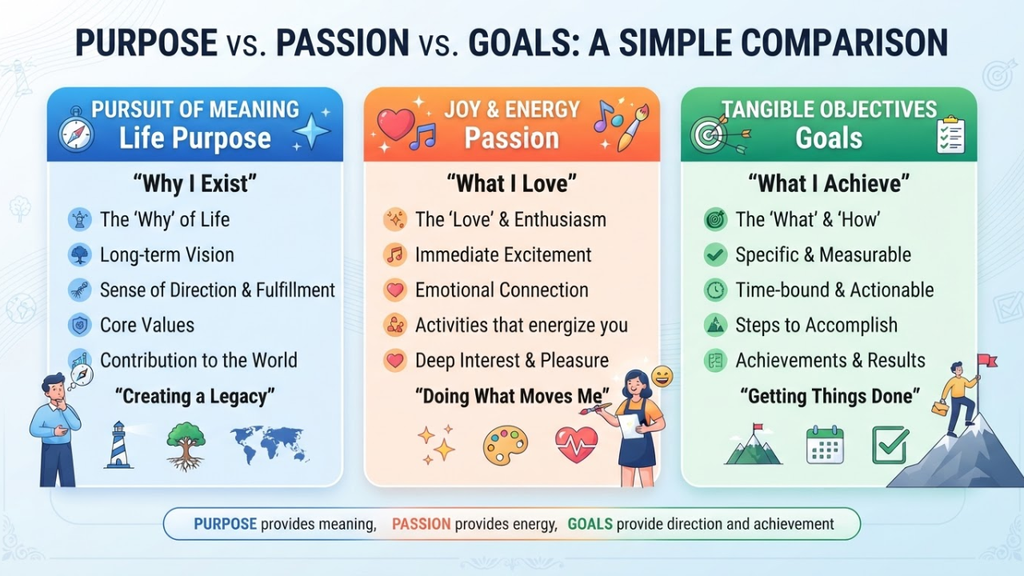
These three get used interchangeably, which is part of why the whole conversation gets muddled.
| Purpose | Passion | Goal |
|---|---|---|
| A meaningful direction that shapes how you spend your time and effort over the long run | Strong enthusiasm or interest—often intense, sometimes short-lived | A specific outcome with an endpoint you either reach or don’t |
| Can exist without excitement | Doesn’t require deeper meaning to be real | Can serve a purpose, or exist without one? |
| Influences which goals feel worth setting | Can point toward a purpose but isn’t proof of one | Usually completed and replaced |
They can work together without being the same thing. A value like “helping people learn” can connect to a strength like “explaining difficult ideas clearly,” which connects to an interest in psychology, which points toward a direction—making useful knowledge easier to access—which might turn into a goal, like building a website, and eventually a career, like writing or teaching.
But there’s no rule that all five have to line up neatly. Most people’s real lives don’t. That’s not a failure state. That’s just what real life looks like.
How Do You Know a Direction Is Worth Exploring?
You don’t need certainty before you try something—you need a few honest signals that it’s worth the attempt.
A direction is probably worth exploring when it matters to you beyond a temporary spike of excitement, when it connects to something you actually value, when your curiosity survives past the initial novelty, when you’re willing to do the unglamorous parts of it and not just the highlight-reel version, and when trying it teaches you something real about yourself, whether or not you end up liking it.
That last one is the important one. An experiment doesn’t need to prove “this is my purpose.” It only needs to answer, “Is this worth exploring further?”—and sometimes the honest answer is no, which is still useful information, not a wasted attempt.
One more thing worth saying plainly: difficulty is not proof you’re on the wrong path. Some of the most meaningful things people do are also some of the hardest. Don’t mistake friction for a wrong turn.
The 7-Day Purpose Discovery Experiment
You will not discover your entire life purpose in seven days, and anyone who promises that is selling something. What you can do in seven days is gather noticeably better information about yourself than you currently have.
Day 1 — Notice. Write down five things that caught your attention today—what interested you, what frustrated you, and what you kept thinking about.
Day 2 — Values. List five values. Narrow to your top three. For each, ask why it actually matters to you.
Day 3 — Strengths. Write five things you do reasonably well. Circle the ones you’d actually want to get better at.
Day 4 — Meaning. Recall three experiences that felt worthwhile, big or small. Ask what made them that way.
Day 5 — Patterns. Reread everything so far. Circle whatever keeps repeating—teaching, independence, problem-solving, whatever it is.
Day 6 — Experiment. Pick one small, real action connected to a pattern you found. Do it.
Day 7 — Reflect and refine. Ask what you learned, what surprised you, what didn’t fit, and what you want to explore next. Then write one sentence:
“I want to explore using my ______ to ______ because I value ______, and I want to contribute to ______.”
That sentence is not a permanent mission statement. It’s a working hypothesis—one you’re allowed to test, revise, or throw out entirely once you have more evidence.
What If Your Purpose Changes?
It probably will, and that’s not a sign you got it wrong the first time.
People change. Responsibilities shift. Relationships end and begin. Your understanding of yourself sharpens with every year you’re forced to actually live with your own decisions. A direction that fit perfectly at 26 might not fit at 41—not because you were naive back then, but because you’ve since learned things you couldn’t have learned any other way except by living them.
Think of purpose less like a fixed destination and more like a compass. A compass doesn’t map out every step of the route. It just tells you, at any given moment, which way you’re currently facing—which is often exactly the information you need.
What If You Still Can’t Find Your Purpose?
Don’t force an answer you don’t actually have yet. Most of the time, the missing ingredient isn’t more thinking—it’s more experience. If you’ve never tried a thing, met the people who do it, or built the skill involved, there’s a limit to how much clarity pure reflection can hand you.
So: try things. Talk to people you trust about what they’ve noticed in you. Give yourself more time than you think you deserve to give yourself. And keep gathering evidence, one small experiment at a time.
One honest note, because this matters: if what you’re feeling isn’t uncertainty about direction but something heavier—persistent hopelessness, or real difficulty functioning day to day—that’s not something a purpose exercise is built to address, and it shouldn’t be treated as a substitute for talking to a professional who can actually help.
Frequently Asked Questions
How do I find my life purpose?
Pay attention to recurring patterns in your interests, values, strengths, meaningful experiences, and what you want to contribute. Then test possible directions through small real-world experiments rather than trying to think your way to certainty. Clarity tends to come from the combination of reflection and experience, not from one sudden realization.
How do I find my purpose in life when I feel lost?
Feeling lost and lacking purpose are related but not identical—it’s worth reading Why Do I Feel Lost in Life? First, since the feeling of being lost often needs to be addressed before purpose work will stick.
Can my career be my life purpose?
It can express it. It doesn’t have to contain all of it. Purpose can also live in relationships, creativity, community, learning, and service—parts of life no job title captures.
What if I don’t have a passion?
Start with curiosity instead—it’s a lower, more honest bar. Try something small, pay attention to what happens, and let interest build from there rather than waiting for it to arrive first.
Can your life purpose change?
Yes, and it often should. Changing direction as your values, responsibilities, and self-understanding evolve isn’t failure—it’s closer to evidence that you’re paying attention.
How long does it take to find your purpose?
There’s no universal timeline, and anyone offering you one is guessing. A more useful question than “How long will this take?” is “What can I learn about myself next?”
Can a personality test tell me my life purpose?
It can be a useful prompt for reflection. It can’t hand you an objective answer, because no test can determine, from outside your life, what you find meaningful inside it.
Do I need to know my purpose before taking action?
No—and waiting for certainty first is one of the most common ways people stay stuck for years. Action generates the information that reflection alone can’t.
Final Thought: You Don’t Need the Whole Map
Most advice about finding your purpose treats it like there’s one hidden answer, sitting somewhere, waiting for you to be worthy enough to find it.
Real life is less dramatic than that and more workable. You notice something. You get curious. You reflect on why. You spot a pattern. You test it. You learn something you didn’t expect. You adjust. You try again.
You don’t need to know where your life is ultimately headed. You don’t need one perfect career, one grand mission, or certainty before you’re allowed to begin. You need enough self-awareness to recognize what matters, enough willingness to test it in the real world, and enough flexibility to update your answer as you go.
So instead of asking, “What is my one true purpose?” Try asking, “What matters to me, what can I actually contribute, and what’s worth exploring next?”
That question, unlike the first one, has an answer you can start on today. Write down three things that have repeatedly mattered to you, and pick one small experiment to try this week.
If you’re reading this because you feel lost more than undirected, start with Why Do I Feel Lost in Life? If you’re still unclear on what “purpose” even means before you go further, what is life’s purpose? is the place to go next.
FAQs
How do I find my life purpose?
Pay attention to recurring patterns in your interests, values, strengths, meaningful experiences, and what you want to contribute. Then test possible directions through small real-world experiments rather than trying to think your way to certainty. Clarity tends to come from the combination of reflection and experience, not from one sudden realization.
How do I find my purpose in life when I feel lost?
Feeling lost and lacking purpose are related but not identical—read “Why Do I Feel Lost in Life?” first, since the feeling of being lost often needs to be addressed before purpose work will stick.
Can my career be my life purpose?
It can express it. It doesn’t have to contain all of it. Purpose can also live in relationships, creativity, community, learning, and service—parts of life no job title captures.
What if I don’t have a passion?
Start with curiosity instead—it’s a lower, more honest bar. Try something small, pay attention to what happens, and let interest build from there rather than waiting for it to arrive first.
Can your life purpose change?
Yes, and it often should. Changing direction as your values, responsibilities, and self-understanding evolve isn’t failure—it’s closer to evidence that you’re paying attention.
How long does it take to find your purpose?
There’s no universal timeline, and anyone offering you one is guessing. A more useful question than “How long will this take?” is “What can I learn about myself next?”
Can a personality test tell me my life purpose?
It can be a useful prompt for reflection. It can’t hand you an objective answer, because no test can determine, from outside your life, what you find meaningful inside it.
Do I need to know my purpose before taking action?
No—and waiting for certainty first is one of the most common ways people stay stuck for years. Action generates the information that reflection alone can’t.
Final Thought: You Don’t Need the Whole Map
Most advice about finding your purpose treats it like there’s one hidden answer, sitting somewhere, waiting for you to be worthy enough to find it.
Real life is less dramatic than that and more workable. You notice something. You get curious. You reflect on why. You spot a pattern. You test it. You learn something you didn’t expect. You adjust. You try again.
You don’t need to know where your life is ultimately headed. You don’t need one perfect career, one grand mission, or certainty before you’re allowed to begin. You need enough self-awareness to recognize what matters, enough willingness to test it in the real world, and enough flexibility to update your answer as you go.
So instead of asking, “What is my one true purpose?” Try asking, “What matters to me, what can I actually contribute, and what’s worth exploring next?”
That question, unlike the first one, has an answer you can start on today. Write down three things that have repeatedly mattered to you, and pick one small experiment to try this week.
If you’re reading this because you feel lost more than undirected, start with Why Do I Feel Lost in Life? If you’re still unclear on what “purpose” even means before you go further, what is life’s purpose? is the place to go next.