What Is Life Purpose? A Practical Guide to Finding Meaning
There’s a particular kind of quiet that shows up after you’ve achieved something you thought would change everything—a promotion, a graduation, a goal you’d chased for years—and it doesn’t. You look around and think, Is this really what I’m meant to be doing?
That question doesn’t always arrive during a crisis. Sometimes it shows up on an ordinary Tuesday, for no obvious reason at all. Nothing is technically wrong. You still feel like something’s missing.
If that sounds familiar, you’re not lost. You’re probably just looking for a stronger sense of direction—which is a different problem and a more solvable one.
Most people carry around an inflated idea of what “life purpose” means. Somewhere along the way, we absorbed the story that everyone has exactly one calling, that it’s waiting to be discovered like a hidden object, and that the people who seem successful simply found theirs earlier than the rest of us. It’s a tidy story. It’s also mostly wrong.
Purpose tends to build itself in less dramatic ways—through the choices you keep making, the values you keep returning to, the strengths you develop without quite noticing, and the small ways you end up contributing to people and things beyond yourself.
This guide walks through what life purpose actually means, why the concept matters, the myths that make it feel harder than it needs to be, and a practical framework—the Purpose Layers Framework—you can use to start exploring your own direction today.
You won’t finish this article with a single sentence that explains your entire future. You’ll finish it with something more useful: a clearer way of thinking about purpose and a next step you can actually take.
What Is Life Purpose?
At its core, life purpose is a sense of direction that gives meaning to how you live and helps guide the choices you make. The American Psychological Association’s Dictionary of Psychology describes purpose in life along similar lines—as a mental sense of a goal or aim in the process of living.
That definition is accurate. It’s also not especially useful on its own, so here’s a more workable version:
Purpose is the direction that connects what matters to you with how you choose to live.
It isn’t one job. It isn’t a single achievement, and it doesn’t need to be a tidy sentence that sums up your entire existence. Purpose shows up through work, relationships, family, creativity, learning, service, and community—often several of these at once.
A teacher might find purpose in helping students think for themselves. A founder might find it in solving a problem that genuinely bothers them. A parent might find theirs largely inside their own home, in the day-to-day work of raising a family well. None of these is more legitimate than the others. There is no career, lifestyle, or milestone that automatically makes a life “purposeful”—and none that disqualifies one either.
Purpose Isn’t the Same as Passion
Passion and purpose get used interchangeably, but they’re not the same thing. Passion is usually about intensity—something you feel strongly drawn to or excited about. Purpose is broader; it’s about the meaning and direction underneath how you live.
Someone can be passionate about photography while their deeper purpose is actually about helping people hold on to their memories or tell their story honestly. The passion is the entry point. The purpose is what it’s in service of.
And not every passion needs to become a career. Some things are worth doing simply because you enjoy them—that’s a complete answer on its own.
Purpose Isn’t the Same as a Goal
Goals describe what you’re trying to accomplish. Purpose explains why it matters.
Goal: Write a book. Purpose: Share knowledge that helps people solve a problem you genuinely care about.
Goals get completed and then replaced by the next one. Purpose is more durable—it can guide you across many different goals, even ones you haven’t thought of yet.
Purpose Isn’t a Fixed Destination
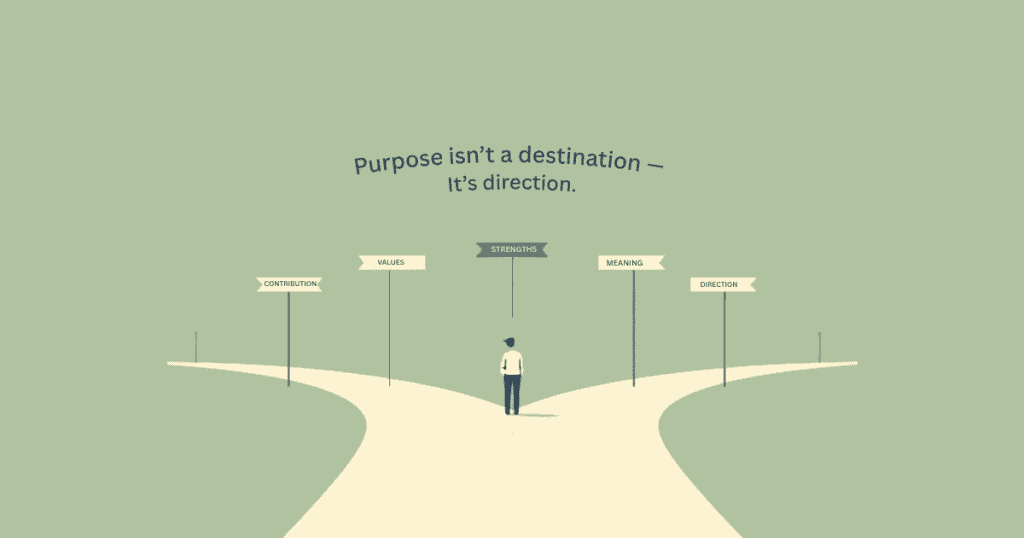
Perhaps the most useful shift in thinking is this: treat purpose as a direction, not a destination.
Your responsibilities change. Your self-understanding changes. What you’re capable of and what you care about both shift over the years—sometimes gradually, sometimes all at once. It would be strange if your sense of purpose never moved at all. A change in direction doesn’t mean your earlier direction was a mistake. More often, it means you grew into a clearer view of yourself.
Why Does Life Purpose Matter?
Purpose isn’t a guarantee of happiness or an easier life. People with a strong sense of purpose still have hard days, still lose jobs, still grieve. But research does point to meaningful associations between having a sense of purpose and several markers of psychological and physical well-being.
A 2023 meta-analysis pooling 99 samples and more than 66,000 participants found that greater purpose in life was associated with lower levels of depression and anxiety. Because these are correlational studies, they shouldn’t be read as proof that purpose causes better mental health—only that the two tend to move together.
A separate 2017 systematic review and meta-analysis, covering 66 studies and more than 73,000 participants, found weak-to-moderate associations between meaning in life and physical health outcomes. And a more recent 2026 meta-analysis of 25 samples involving nearly 489,000 participants found that greater purpose was associated with a lower risk of mortality—an association the researchers noted was partly explained by behavioral, clinical, and psychological factors, rather than purpose acting as some independent life-extending force.
(A note on the research above: numbers and findings like these get cited constantly online, sometimes inaccurately. It’s worth verifying the specific studies yourself before relying on them.)
So setting the research aside for a moment, why does purpose actually matter day to day?
It gives your choices a reference point. Most days bring a string of small decisions and, occasionally, a large one. Knowing roughly what matters to you gives you something to measure choices against—which opportunities to take, which to decline, and which relationships and commitments are worth protecting. It won’t make every decision easy. It tends to make some of them clearer.
It reframes ordinary effort. The same task can feel completely different depending on what you think it’s for. Studying can just be studying—or it can be evidence of your commitment to growth. A job can just be a paycheck—or it can represent providing for people you love, sharpening a skill, or building something you believe in. The task itself hasn’t changed. Your relationship to it has.
It helps you keep going when motivation doesn’t show up. Motivation is unreliable by nature—it comes and goes regardless of how important something is. Purpose doesn’t fix that, and it won’t erase exhaustion or bad days. What it can do is give your effort a reason to continue even when the feeling of wanting to isn’t there.
Five Myths That Make Purpose Feel Harder Than It Is
Most people aren’t struggling with purpose because the concept is genuinely confusing. They’re struggling because they’ve absorbed a few bad assumptions about what it’s supposed to look like. Worth naming them directly.
Myth 1: Everyone has exactly one perfect purpose, waiting to be found. This idea puts enormous pressure on a single decision, as if choosing wrong means failing at life. In reality, a meaningful life usually holds several directions at once—through family, work, creativity, and community, often shifting in emphasis over time. A better question than “what am I meant to do?” is: What meaningful direction do I want to explore in this season of my life?
Myth 2: Your purpose has to be your career. Work can be a real expression of purpose, but it doesn’t have to hold your entire identity. Someone with a job that pays the bills and nothing more can still be deeply purposeful—through how they parent, how they show up for friends, and what they build outside of work hours. If your job doesn’t feel like a calling, ask instead: where else in my life am I already living out what matters to me?
Myth 3: Purpose arrives in one dramatic moment of clarity. The “lightning bolt” story is memorable precisely because it’s rare. For most people, purpose accumulates—you try something, notice how it feels, adjust, and try again. A woman who starts volunteering at an animal shelter out of boredom and, three years later, is running a rescue nonprofit didn’t have a single epiphany. She had a slow accumulation of small, informative choices.
Myth 4: Once you find your purpose, it should never change. You’re not the same person you were five years ago, and you won’t be the same person five years from now. As your circumstances and self-knowledge shift, it’s normal for your sense of direction to shift with them. Changing course isn’t automatically a failure — sometimes it’s proof you learned something worth acting on.
Myth 5: A purposeful life has to look impressive from the outside. Social media rewards the announcement—the new business, the big pivot, the “I finally found my why” post. That creates a distorted picture where an ordinary life can start to feel like a failed one. It isn’t. Someone raising a family with care, doing solid work, showing up for a friend, or quietly supporting their community is living about as purposeful a life as exists. Purpose isn’t measured by how impressive it looks to strangers.
The Purpose Layers Framework

If you’re trying to work out your own sense of purpose, the instinct is usually to ask, “What am I meant to do?” That question is almost too big to answer—which is exactly why it stalls people out.
A more workable question is, “What parts of my life are already pointing toward what matters to me?”
That’s the question the Purpose Layers Framework is built to help you answer. It’s a purpose-unfolded reflection tool—not a scientifically validated psychological instrument—designed to help you examine five connected areas of your life and notice where the patterns line up.
| Layer | The Question It Asks |
|---|---|
| Daily Actions | What do I repeatedly do? |
| Strengths | What can I do well or develop? |
| Values | What matters enough to guide my choices? |
| Meaning | What makes life feel worthwhile? |
| Contribution | What positive difference do I want to make? |
Layer 1: Daily Actions
Purpose isn’t only what you say matters—it also shows up in what you actually do with your time. Where does it go once you subtract sleep and obligation? What do you keep returning to without being told to? What do people come to you for help with?
None of this proves anything on its own. But patterns are worth paying attention to.
Ask yourself: if someone watched how I spent the last month, what would they conclude I care about?
Layer 2: Strengths
Purpose isn’t only about what you care about—it’s also about what you have to offer. Strengths can be concrete skills (writing, teaching, organizing, designing, solving problems) or less tangible qualities (patience, curiosity, reliability, empathy). You don’t need to be exceptional at something for it to count. Strengths tend to grow more valuable the more deliberately you use them.
Ask yourself: what do people regularly come to me for? And which of those abilities would I actually like to get better at?
Layer 3: Values
Values are the principles you want your decisions to reflect—things like family, freedom, learning, creativity, service, growth, honesty, community, courage, or compassion.
The trap here is choosing values because they sound admirable rather than because they’re true. If you say freedom matters to you but keep choosing environments with almost no autonomy, that gap is worth investigating rather than ignoring.
Ask yourself, what principles do I want my decisions to reflect, even when following them is inconvenient?
Layer 4: Meaning
Meaning is personal, and it doesn’t require ease or enjoyment. Something difficult—a hard conversation, a demanding project, caring for someone through illness—can be some of the most meaningful work you ever do.
Ask yourself: when have I felt that what I was doing genuinely mattered? Look for significance here, not just pleasure. They’re related, but they’re not the same thing.
Layer 5: Contribution
This is the layer that shifts the question from “what do I want from life?” to “what do I want my life to give?”
Contribution doesn’t require changing the world. It can mean helping your family, mentoring one person, creating work that’s genuinely useful, supporting your community, or teaching something you know. Small and real beats large and vague.
Ask yourself: Who or what do I want to be better because I am here?
How the Five Layers Connect
The value of this framework isn’t in any single layer—it’s in what happens when you look at them side by side.
Take someone who enjoys teaching, is genuinely good at explaining complicated ideas simply, values learning and service, finds real meaning in watching people grow, and wants to make useful knowledge easier to reach. Individually, none of those facts is a career plan. Together, they point in a clear direction—even though the specific job title is still up for grabs. That person could teach. They could write. They could mentor or build a resource that does some of that work at scale. The point isn’t to arrive at one answer; it’s to narrow the field to options that actually fit.
Purpose gives you direction. It doesn’t hand you a job title—that part is still yours to figure out.
A Simple Purpose Alignment Check
Score each layer from 1 (very unclear or disconnected) to 5 (very clear and aligned).
| Layer | Score |
|---|---|
| Daily Actions | ___ / 5 |
| Strengths | ___ / 5 |
| Values | ___ / 5 |
| Meaning | ___ / 5 |
| Contribution | ___ / 5 |
Now look at your lowest score—not as a verdict, but as a place to dig further.
- Low on Values? Spend more time working out what genuinely matters, rather than what should.
- Low on Daily Actions? You may already know what matters but aren’t expressing it in how you actually spend your time.
- Low on Contribution? It might be worth exploring how your effort could benefit something beyond yourself.
The point of this exercise was never a perfect score. It’s better to ask questions.
How to Start Building Your Sense of Purpose
You don’t need your whole life mapped out before you take the next step. Purpose gets clearer through reflection and action—not one without the other. Here’s where to start.
1. Notice what already matters. Write down five moments when you felt engaged, useful, proud, connected, or genuinely glad you spent your time that way. Look for what they have in common.
2. Name your values, specifically. Pick three to five that genuinely matter and define each in your own words—not the dictionary version. “Learning,” for instance, might mean I want to stay curious and keep building my understanding, even outside my job. Then ask, “What would actually change if I took this more seriously?”
3. Take honest stock of your strengths. Make two short lists—skills you can point to and qualities people tend to appreciate in you. You don’t need to already be an expert at either; you just need a starting inventory.
4. Get specific about contribution. Who or what do you want your effort to help? Family, community, customers, students, a specific problem—it doesn’t need to be grand. Small and real beats abstract and impressive.
5. Take one purpose-aligned action. This is the step most people skip. They journal, reflect, and think it through—and then nothing changes. Instead, pick one small action that ties several layers together.
Example: Value = Learning. Strength = Writing. Contribution = Helping beginners. Action: Write a short, honest guide to something you’ve already learned the hard way.
Another example: Value = Community. Strength = Organizing. Contribution = Helping others. Action: Volunteer for one local event once.
The action doesn’t need to reveal your entire purpose in one go. It gives you information. Afterward, ask: “What did I learn about myself by actually doing this?” That answer is another piece of the puzzle.
Don’t Wait for Certainty
One of the biggest obstacles to finding purpose is believing you need total certainty before you’re allowed to start. In practice, clarity almost always comes after movement, not before it. You take a step, learn something, adjust, and take another.
Think of purpose less like a fixed destination on a map and more like a compass. You don’t need to see the whole route to know which direction to walk in next.
What If You Still Don’t Know Your Purpose?
That’s genuinely fine. You can work through every exercise in this article and still land on “I don’t know.” Don’t let that turn into another reason to be hard on yourself.
Start smaller. Try something you’ve been curious about. Learn a skill you’ve been putting off. Have a real conversation with someone whose work interests you. Volunteer once, even if you’re not sure it’ll lead anywhere. Pay attention to what energizes you and what feels meaningful—and treat that as evidence, not as a verdict.
Sometimes the more useful question isn’t “What is my purpose?” It’s, “What’s one meaningful thing I can do next?”
Put It Into Practice: The Purpose Layers Worksheet
Reading about purpose gives you ideas. Writing your own answers down is what actually forces you to examine them. Set aside 20–30 minutes and answer honestly—half-answers are fine; blank ones aren’t.
Layer 1 — Daily Actions What do I repeatedly spend my time doing? What does that reveal about what currently matters to me?
Layer 2 — Strengths Three skills I can use: Three personal qualities I bring: Which strength would I like to develop further?
Layer 3 — Values My three to five most important values: living my top value would mean one decision I could make differently because of them.
Layer 4 — Meaning Three experiences that felt meaningful to me: What made them meaningful?
Layer 5 — Contribution Who or what do I want to positively affect? The difference I’d like to make is the following:
Bring it together: What I value most: A strength I can use: An activity that gives me meaning: A person, group, or problem I care about: A direction I want to explore:
Your Seven-Day Purpose Experiment
Skip the perfect life-purpose statement. Run a small experiment instead. Pick one action, doable within seven days, that connects at least three of the five layers.
This week, I will: When will I do it? What do I hope to learn from it?
Once you’ve done it, ask, “What did this teach me about what matters to me?” That’s the part that actually counts.
Your First Purpose Statement
If you want to put your current thinking into a single sentence, try this template:
I want to use my ________ to ________ because I value ________, and I want to contribute to ________.
Treat it as a snapshot of where you are right now—not a permanent mission statement carved into stone. It’s allowed to change as you do.
FAQs About Life Purpose
Does everyone have a life purpose?
There’s no single definition of purpose that applies to everyone the same way. Some people develop a strong sense of it early; others build it slowly, over years. You don’t need to believe in one predetermined mission to live a meaningful life—a solid starting point is simply asking what matters to you and how you can express that through how you live.
Can my life purpose change?
Yes. As your priorities and responsibilities shift, your sense of purpose can reasonably shift with them. A change in direction doesn’t mean the earlier one was wrong—it often means you learned something new. It’s worth periodically asking, “Does the direction I’m moving in still reflect what matters to me?“
Is life purpose the same as passion?
No. Passion usually describes strong interest or enthusiasm about something specific. Purpose is broader—it’s about the meaning and direction behind how you live overall. A passion can become one expression of your purpose, but it doesn’t have to become your career.
What if I don’t know my purpose?
Start by gathering information about yourself: what interests you, what problems you care about, what people ask you for help with, which values matter most, which experiences feel meaningful, and how you naturally contribute. Then experiment—try something, learn from it, adjust. Purpose tends to get clearer through action, not just thinking.
Can I have more than one purpose?
You don’t have to compress your entire life into a single purpose. Family, work, relationships, creativity, learning, and service can each carry their own kind of meaning, and they don’t have to compete—they’re often just different expressions of the same underlying values.
Does my career need to match my purpose?
No. Your job can be a meaningful expression of purpose, but it doesn’t have to carry the entire weight of it. Purpose can live in relationships, family, creativity, volunteering, learning, and community just as legitimately as it lives in a career.
Can purpose exist during difficult times?
Yes. Hard circumstances don’t erase purpose—sometimes they’re exactly what causes people to reconsider what matters most in the first place. You don’t need hardship to have purpose, and struggling doesn’t mean you’ve failed to live purposefully. During a hard season, purpose might simply mean taking care of yourself, showing up for someone you love, or getting through one meaningful step at a time.
Purpose Is Built, One Choice at a Time
You may have opened this article hoping for a clean answer to “what is my life purpose?” There isn’t a universal sentence that answers that for you—and that’s not a disappointing conclusion. It’s a fairly freeing one.
You don’t need to locate one perfect destination before you’re allowed to start living meaningfully. Start with what you already have in front of you. Notice your daily actions. Develop your strengths. Get honest about your values. Pay attention to what actually feels meaningful. Think about how you want to contribute. Then take one small action that pulls those pieces a little closer together.
That’s the entire logic behind the purpose layers framework—purpose isn’t something you have to perfectly discover before you’re allowed to live it. It develops through the way you choose, act, adjust, and contribute, repeated over a long stretch of ordinary days.
So instead of asking only, “What is my purpose?” try asking, “What matters to me, and what can I do about it next?”
That question actually gives you somewhere to start. A meaningful life is rarely the product of one extraordinary decision. It’s usually built from hundreds of ordinary ones that happen to point in the same direction.
Start with one.
Life purpose isn't about finding a perfect answer.

It's about making choices that consistently move you toward a life that reflects your values, uses your strengths, and contributes to something beyond yourself.